






What's Happening?
Mollie Hemingway, editor-in-chief of The Federalist and a Fox News contributor, reported an encounter at Washington Dulles International Airport where she claimed two foreign-born TSA officers lacked sufficient English language skills to answer basic
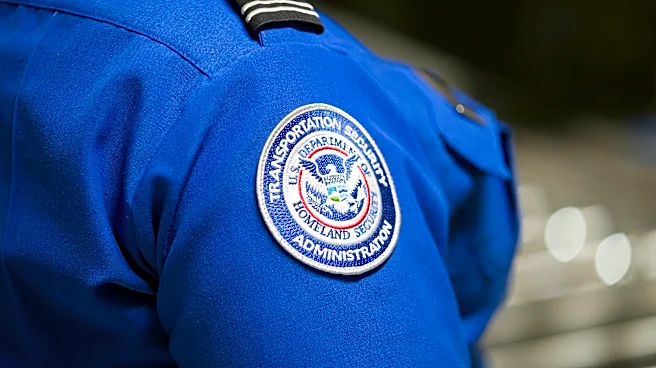
questions. This personal account, shared on August 20, has sparked a wider discussion regarding the consistency of English proficiency among Transportation Security Officers (TSOs). The Transportation Security Administration (TSA) explicitly requires TSOs to be proficient in reading, writing, and speaking English to perform their duties, communicate with travelers, and follow security procedures. Hemingway's experience, while an individual incident, has brought attention to whether these established English language standards are being consistently met and enforced within the agency. The incident has led to public debate about TSA hiring practices, training, and accountability, particularly concerning the communication skills of frontline personnel who interact directly with the traveling public.
Why It's Important?
The incident at Dulles Airport highlights the critical importance of clear communication in airport security. TSOs are frontline personnel responsible for screening passengers and property, providing directions, and responding to inquiries in a fast-paced and often stressful environment. Effective communication is not merely a customer service issue; it is integral to maintaining security and operational efficiency. Misunderstandings due to language barriers could slow down checkpoints, frustrate passengers, or, in more serious scenarios, impede the clear explanation of security instructions or coordination of responses to unexpected situations. While multilingual skills are valued by the TSA for assisting non-English speaking travelers, the core requirement for English proficiency ensures that officers can effectively perform their primary security duties. This discussion underscores the public's expectation that federal agencies, especially those involved in national security, rigorously enforce their own established standards for employee qualifications, including language skills.
What's Next?
Following Mollie Hemingway's account, the focus is likely to shift towards how the TSA assesses and maintains English proficiency among its TSOs. The agency may face increased scrutiny regarding its hiring processes, which include computer-based testing, airport assessments, and medical evaluations, all of which are supposed to confirm English proficiency. Questions may arise about the mechanisms in place to identify and correct communication deficiencies after hiring, and whether officers are periodically evaluated on their communication skills. Supervisors' responses to passenger complaints about communication problems and the effectiveness of ongoing training in addressing communication in high-pressure environments could also be reviewed. The incident may prompt the TSA to reaffirm its commitment to enforcing existing English language standards and potentially review the consistency of their application across different airports and shifts to ensure public confidence in security procedures.
Beyond the Headlines
The debate ignited by Hemingway's experience extends beyond a single incident, touching upon broader implications concerning federal employment, immigration, and public perception of government competence. While the discussion has included references to the officers' foreign-born status, the core issue, as per TSA policy, is not national origin but rather the ability to perform job-related communication functions. This distinction is crucial, as the TSA's directive prohibits discrimination based on national origin while simultaneously mandating English proficiency. The incident underscores the delicate balance between valuing multilingualism for diverse passenger assistance and ensuring a baseline of English fluency for critical security roles. It also highlights how public interactions with federal employees, particularly in mandatory and high-stakes settings like airport security, can significantly shape public trust and perceptions of an agency's effectiveness and adherence to its own standards.