


What's Happening?
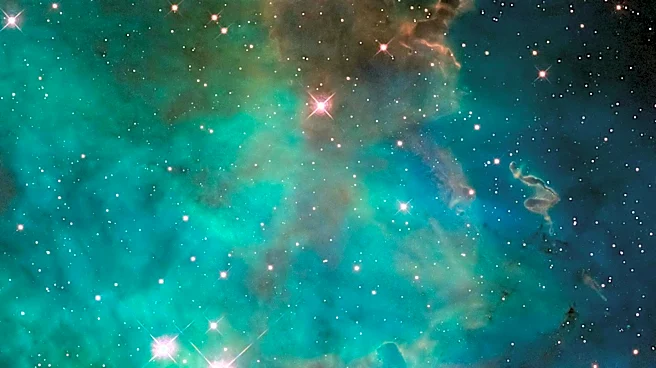
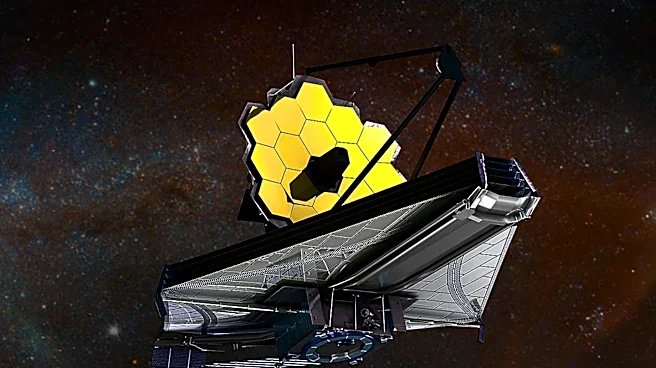
The James Webb Space Telescope (JWST) has captured a detailed image of a prominent dust pillar within the Carina Nebula, a vast region of star formation in our Milky Way galaxy. This towering formation of interstellar gas and dust is being sculpted by
the intense radiation and stellar winds emanating from nearby massive stars, including the luminous Eta Carinae system. Within this pillar, a compact cluster of approximately 70 young stars has been identified. The most massive among these stars are about 19 times the mass of our Sun. These young stars are estimated to be only 1.3 million years old, a relatively short period in cosmic terms, highlighting the dynamic and rapid processes of star birth occurring in this region.
Why It's Important?
This observation by the James Webb Space Telescope is crucial for advancing our understanding of stellar evolution and the lifecycle of stars. The JWST's advanced infrared capabilities allow astronomers to penetrate the dense dust and gas clouds that typically obscure star-forming regions, revealing the hidden processes of star birth in unprecedented detail. Studying these young star clusters provides vital data on how massive stars form and influence their environments through powerful radiation and stellar winds. This insight helps scientists refine models of galactic evolution and the distribution of elements in the universe. The Carina Nebula serves as a natural laboratory for observing these fundamental cosmic processes, offering clues to the origins of stars, including our own Sun.
What's Next?
Astronomers will continue to analyze the data from the JWST's observations of the Carina Nebula to gain deeper insights into the formation and early evolution of stars. Future studies will likely focus on the detailed characteristics of the 70 young stars within the dust pillar, including their masses, temperatures, and evolutionary stages. Researchers will also investigate the precise mechanisms by which the intense radiation from massive stars shapes and erodes the surrounding gas and dust, potentially triggering or inhibiting further star formation. The JWST's ongoing mission promises to deliver more such detailed images and spectroscopic data from other star-forming regions, further enriching our understanding of the universe's stellar nurseries.
Beyond the Headlines
The stunning images from the James Webb Space Telescope, such as this one of the Carina Nebula, transcend scientific importance by inspiring public interest in space exploration and astronomy. These visuals offer a tangible connection to the vastness and beauty of the cosmos, fostering a sense of wonder and encouraging scientific literacy. On a deeper level, understanding star formation helps us comprehend our own origins, as the elements that make up Earth and life itself were forged in the hearts of stars. The study of these cosmic nurseries also highlights the extreme conditions and immense timescales involved in astrophysical processes, providing a humbling perspective on humanity's place in the universe. The JWST's ability to peer through cosmic dust also symbolizes humanity's persistent quest to uncover hidden truths and expand the boundaries of knowledge.