









What's Happening?
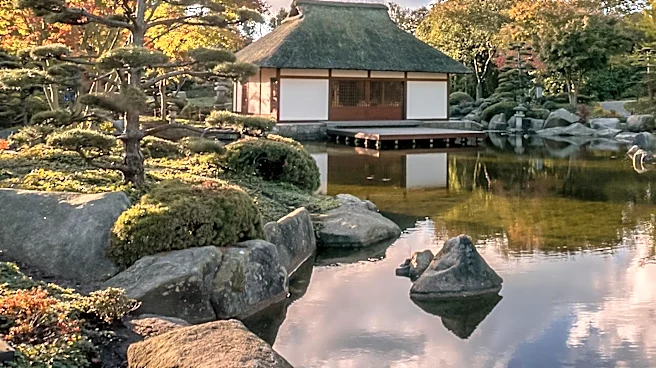
San Antonio's Japanese Tea Garden has installed a new faux bois covering over the words 'Chinese Tea Garden' on its entrance gate, addressing a historical wrong stemming from World War II. Following Japan's attack on Pearl Harbor in December 1941, the city
evicted the Japanese American Jingu family, who had operated the garden for years. Amid widespread anti-Japanese sentiment, the park was renamed the Chinese Tea Garden, and the new entrance gate, constructed in 1942, prominently displayed this name. Although the park's original name, Japanese Tea Garden, was restored in 1984, the gate's lettering remained. Artist René Romero created a concrete plank that covers the original inscription, preserving the historic artwork while reflecting the garden's current name. San Antonio Parks Foundation CEO Mary Jane Verette emphasized the importance of acknowledging complex histories and learning from them.
Why It's Important?
This action by the San Antonio Parks Foundation highlights a significant effort to reconcile with a painful chapter of American history, specifically the discrimination faced by Japanese Americans during World War II. The eviction of the Jingu family and the renaming of the garden reflect the broader anti-Japanese sentiment and policies, such as internment, that impacted communities across the U.S. The solution of covering, rather than removing, the original inscription demonstrates a nuanced approach to historical preservation, aiming to acknowledge past injustices without destroying historical artifacts. This initiative serves as a model for other institutions grappling with similar historical controversies, promoting healing and education within communities.
What's Next?
The new installation at the Japanese Tea Garden is expected to foster continued dialogue about historical discrimination and the importance of cultural sensitivity. The San Antonio Parks Foundation will likely continue educational efforts to inform visitors about the garden's complex past and the significance of the recent change. This move could also inspire other historical sites across the U.S. to re-evaluate their own narratives and consider similar actions to address historical inaccuracies or injustices. The preservation of the original artwork while updating its visible message sets a precedent for balancing historical integrity with contemporary values of inclusivity and recognition.
Beyond the Headlines
The decision to cover the 'Chinese Tea Garden' inscription rather than remove it delves into deeper questions of historical memory and the ethics of altering historical artifacts. It reflects a desire to acknowledge the past, including its uncomfortable truths, without erasing the physical evidence of those events. This approach can be seen as a form of 'restorative justice' for historical narratives, allowing for a more complete and honest understanding of the past. It also underscores the ongoing impact of geopolitical events, like World War II, on local communities and the long-term efforts required to address their legacies. The use of faux bois, an art form with its own history in San Antonio, to correct a historical wrong adds another layer of cultural significance to the project.