








What's Happening?
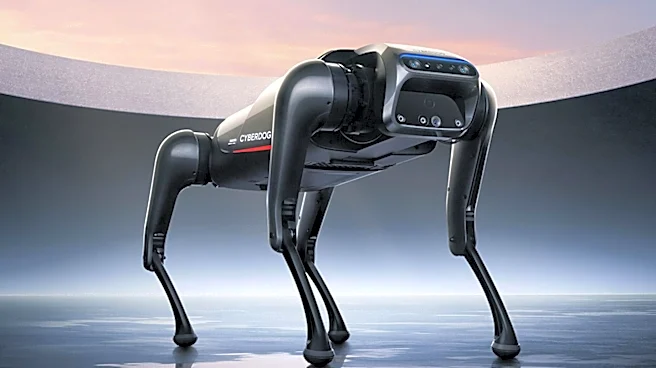
Dozens of humanoid and canine robots participated in the World Mountain Robot Challenge on Mount Tai in China. This event, organized by the state-run China Media Group, served as a real-world endurance test for machines, requiring them to navigate over
3,000 steps and a 600-meter ascent along a 3.9-kilometer course. Teams from approximately 90 organizations tasked their robots with either completing the route as quickly as possible or transporting fragile items like eggs and watermelons to the summit. The challenging terrain of Mount Tai, a UNESCO World Heritage site, proved difficult for some robots, with one humanoid robot collapsing and another tripping down a flight of stairs. A canine robot from Beijing Lingyi Technology, a subsidiary of Unitree, successfully completed the course in 43 minutes and 41 seconds, winning the four-legged speed category. Organizers described Mount Tai's rocky landscape as a 'natural extreme testing ground' for robot training.
Why It's Important?
This robot challenge is significant as it pushes the boundaries of robotic capabilities in real-world, unstructured environments. Unlike controlled laboratory settings, the rugged and unpredictable terrain of Mount Tai provides invaluable data for developing more robust and adaptable robots. The ability of robots to navigate such challenging landscapes and perform tasks like carrying fragile goods has direct implications for various industries, including disaster relief, exploration, logistics, and even personal assistance in difficult environments. The competition highlights the ongoing advancements in robot locomotion, balance, and autonomy. The insights gained from such events can accelerate the development of robots that can operate effectively outside of factory floors, potentially leading to new applications and markets for robotic technology globally. The participation of numerous teams also fosters innovation and competition within the robotics sector.
What's Next?
The data and experiences gathered from the World Mountain Robot Challenge will likely inform future research and development in robotics, particularly in areas of locomotion, sensor integration, and AI for navigation in complex environments. Engineers will analyze the performance of the robots, identifying weaknesses and areas for improvement in their design and programming. Such challenges are crucial for bridging the gap between theoretical robotic capabilities and practical, real-world applications. Future iterations of similar competitions may introduce even more complex tasks or environments, further pushing the limits of robotic endurance and intelligence. The success of canine robots in this challenge may also encourage further development of quadrupedal robots for tasks requiring stability and agility on uneven terrain. The event also serves as a public demonstration of robotic advancements, potentially inspiring future generations of engineers and increasing public acceptance of advanced robotic technologies.
Beyond the Headlines
The use of a sacred mountain like Mount Tai for a robot challenge subtly underscores the evolving relationship between ancient traditions and cutting-edge technology. While the mountain has historical significance as a pilgrimage site, it now serves as a proving ground for the future of robotics. This juxtaposition highlights a broader cultural shift where technology is increasingly integrated into diverse aspects of society, even those steeped in history. The challenges faced by the robots, such as falls and malfunctions, also serve as a reminder of the current limitations of AI and robotics, emphasizing that while significant progress has been made, true human-like adaptability and resilience are still distant goals. The event also implicitly showcases China's commitment to becoming a leader in advanced technological fields, using high-profile events to demonstrate its capabilities and foster innovation within its domestic tech industry.