



What's Happening?
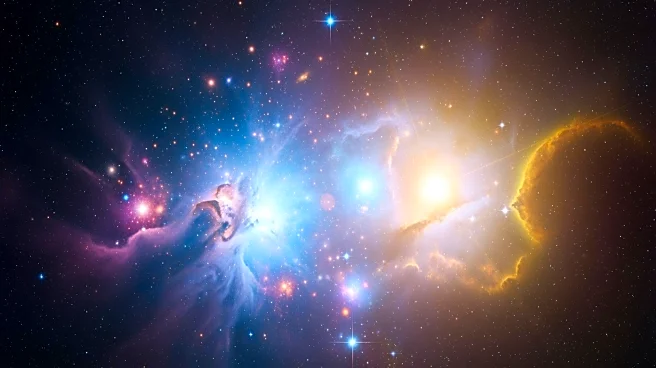
NASA's Hubble Space Telescope has captured new images of infant stars, providing insights into the process of massive star formation. These images, part of the SOFIA Massive Star Formation Survey, reveal protostars shrouded in thick dust, which Hubble can
penetrate using near-infrared emissions. The survey aims to understand the properties of young stars, such as their outflows, environment, mass, and brightness, and how these relate to their evolutionary stages. The images highlight regions like Cepheus A, where a luminous protostar illuminates the surrounding area, and other star-forming regions within the Milky Way. These observations help test theories of massive star formation and contribute to the broader understanding of stellar evolution.
Why It's Important?
The study of star formation is crucial for understanding the lifecycle of stars and the evolution of galaxies. By capturing images of protostars and their environments, the Hubble Space Telescope provides valuable data that can refine existing models of star formation. This research enhances the scientific community's ability to predict the behavior and development of massive stars, which play a significant role in the dynamics of galaxies. The findings from this survey could lead to new insights into the processes that govern the birth and growth of stars, influencing future astronomical research and our understanding of the universe.
What's Next?
The data collected from these observations will be analyzed to further understand the mechanisms of star formation. Researchers will continue to study the properties of these young stars and their environments, potentially leading to new discoveries about the early stages of stellar development. The ongoing survey may also inspire additional studies using other telescopes and instruments, expanding the scope of research in this field. As technology advances, future missions may build on these findings to explore star formation in even greater detail.