
What's Happening?
Geologists have uncovered the largest iron ore deposit ever recorded beneath the Australian outback, valued at $5.7 trillion. This discovery challenges existing geological models and suggests that the ore bodies
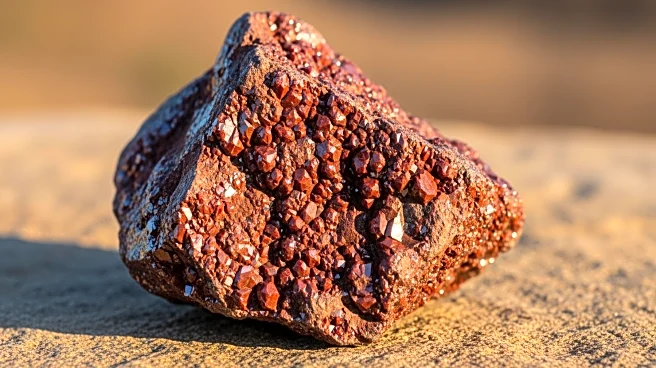
in Western Australia's Pilbara Craton formed between 1.4 and 1.1 billion years ago, rather than during the Great Oxidation Event as previously thought. The study, published in the Proceedings of the National Academy of Sciences, used in situ U–Pb isotopic dating on hematite samples to determine the crystallization age of the iron ore. This methodological shift provides new insights into the formation of mineral deposits and their links to tectonic processes.
Why It's Important?
The discovery of this massive iron ore deposit has significant implications for global geology and the mining industry. It challenges long-held theories about ore formation and suggests a new framework for understanding mineral systems in relation to tectonic activity. Economically, the deposit reinforces Australia's position as a leading iron ore exporter, potentially increasing its influence in global markets. The findings also offer a new exploration strategy for identifying similar deposits in other regions, which could lead to further economic opportunities and advancements in geological research.
What's Next?
Future research will likely focus on understanding the crustal thermal evolution and tectonic processes that led to the formation of this deposit. The techniques used in this study may be applied to other large ore provinces to refine geological timelines and explore the interplay between tectonics and resource distribution. The discovery could prompt a reevaluation of mineral exploration strategies worldwide, particularly in regions with similar geological histories. As researchers continue to investigate, the findings may lead to new insights into the Earth's deep-time tectonics and their impact on modern resource distribution.