









What's Happening?
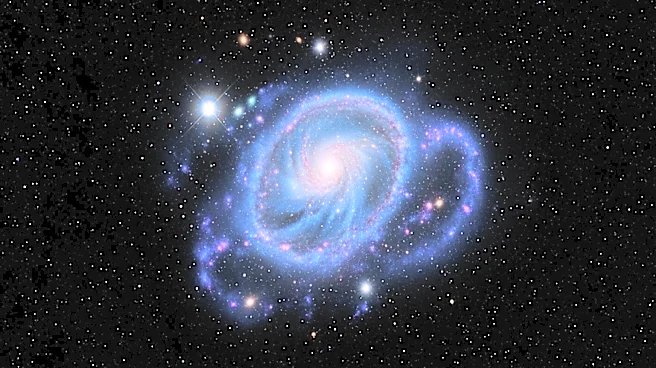
The Hubble Space Telescope has captured a striking image of the irregular dwarf galaxy ESO 490-017, located 23 million light-years away in the constellation Canis Major. This galaxy, measuring about 12,000 light-years across, is significantly smaller
than the Milky Way, which spans at least 100,000 light-years. The image highlights the galaxy's faint surface brightness, with stars appearing hazy in the background, while foreground stars stand out with bright diffraction spikes. The photo also reveals other galaxies scattered throughout space, showcasing Hubble's ability to capture distant and faint cosmic structures. This image is part of a larger Hubble observing program aimed at studying the movement and 'cosmic flow' of galaxies and galaxy clusters.
Why It's Important?
The image of ESO 490-017 contributes to the understanding of galaxy dynamics and the 'cosmic flow' of massive structures in the universe. By studying such distant galaxies, scientists can gain insights into the movement and evolution of galaxies over time. The ability of the Hubble Space Telescope to capture detailed images of faint and faraway galaxies demonstrates its crucial role in advancing astronomical research. This data helps researchers explore the distribution and behavior of galaxies, which is essential for understanding the large-scale structure of the universe and the forces that govern cosmic evolution.