





What's Happening?
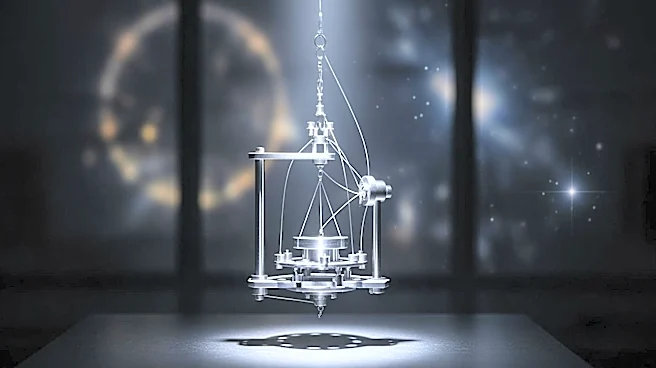
An international team of researchers has utilized torsion-balance experiments to set the strongest direct detection limits yet on ultralight dark matter. These precision instruments, originally designed to test the equivalence principle, have been adapted
to detect interactions between dark matter and nucleons in the mass range from about 0.01 to 1 electronvolt (eV). The study, published in Physical Review Letters, highlights how these experiments can measure tiny accelerations caused by frequent scattering of dark matter particles. The research was conducted by a team including Professor Shigeki Matsumoto and Postdoctoral Research Fellow Jie Sheng from the University of Tokyo's Kavli Institute for the Physics and Mathematics of the Universe. The findings suggest that torsion-balance experiments, with their geometrically asymmetric configurations, are particularly sensitive to dark-matter-induced accelerations, offering a new approach to detecting light dark matter.
Why It's Important?
This development is significant as it opens a new avenue for dark matter research, particularly in the low-mass region where traditional underground detectors have limited sensitivity. By using torsion-balance experiments, researchers can explore interactions between light dark matter and nucleons, potentially leading to breakthroughs in understanding the universe's composition. This method not only enhances the detection capabilities for dark matter but also strengthens the connection between precision measurement experiments and particle cosmology. The ability to detect ultralight dark matter could have profound implications for physics, potentially leading to new theories and models that explain the fundamental nature of matter and the universe.
What's Next?
Future research will likely focus on improving the sensitivity and design of torsion-balance experiments to extend the range of detectable dark matter masses and couplings. As these experiments become more refined, they may provide even more precise measurements, further constraining the properties of dark matter. This could lead to collaborations between physicists and cosmologists to explore new theoretical frameworks and experimental setups. The ongoing advancements in this field may also inspire the development of new technologies and methodologies for detecting other elusive particles, contributing to a deeper understanding of the universe.