







What's Happening?
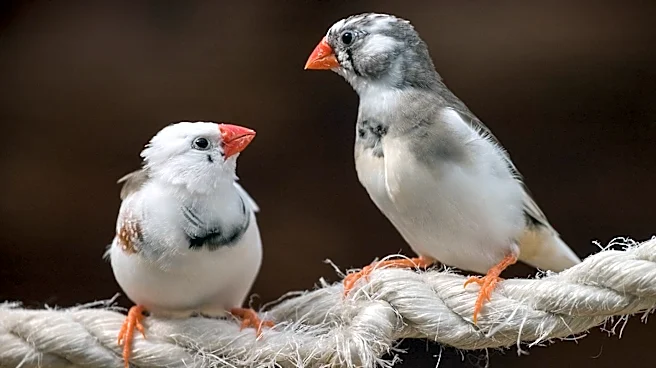
Julie Elie, an associate project scientist in Berkeley's Department of Neuroscience, has spent years studying the vocalizations of zebra finches, a small, social songbird. Her research has led to new insights into bird chatter, which refers to the chirps
made by all flock members throughout the day, distinct from birdsong used for courting and territorial purposes. Elie has compiled an 'audio dictionary' of zebra finches' 'words' or call types, identifying specific meanings such as hunger, distress, alarm, or a need for contact. She validated this dictionary by using operant vocalization-classification tasks, rewarding the songbirds when they completed them. This method allowed her and her team to systematically deepen their understanding of the information conveyed by these finch vocalizations. The study also compared the birds' performance in these tasks with that of AI, demonstrating that finches possess a true understanding of their vocalizations, unlike AI which perceives them as meaningless chatter.
Why It's Important?
This research is important because it provides a deeper understanding of animal communication, specifically within avian species. By decoding the complex 'chatter' of zebra finches, scientists can gain insights into the cognitive abilities of birds and how they convey essential information for survival and social interaction. The distinction between the finches' understanding of their vocalizations and AI's perception highlights the nuanced nature of biological communication versus algorithmic interpretation. This could have implications for future studies in animal behavior, neurobiology, and even the development of more sophisticated artificial intelligence that can better interpret natural communication patterns. Understanding these vocalizations can also contribute to conservation efforts by providing clues about the well-being and needs of bird populations in various environments.
What's Next?
The validated audio dictionary of zebra finch vocalizations opens several avenues for future research. Researchers can now use this dictionary to further explore the social dynamics within finch colonies, observing how these specific calls influence group behavior and decision-making. The comparison with AI's performance suggests potential for developing more advanced AI models that can learn to interpret the contextual meaning of animal vocalizations, rather than just their acoustic properties. This could lead to new tools for monitoring animal populations, understanding their responses to environmental changes, and even developing more effective communication strategies in animal husbandry or wildlife management. Further studies might also investigate whether similar 'chatter' dictionaries can be developed for other bird species, expanding our knowledge of avian communication across the board.
Beyond the Headlines
Beyond the immediate scientific findings, this research touches upon profound questions regarding the nature of language and consciousness in the animal kingdom. The ability of zebra finches to assign specific meanings to their vocalizations and respond accordingly suggests a level of cognitive processing that goes beyond simple instinctual reactions. This challenges anthropocentric views of language and communication, prompting a re-evaluation of how we define and recognize intelligence in non-human species. The methodology employed, which involved direct interaction and reward-based tasks, underscores the importance of multimodal observation in understanding animal behavior, emphasizing that human interpretation and contextual understanding are crucial for deciphering complex biological signals. This work could inspire ethical considerations in how humans interact with and study animals, fostering a greater appreciation for their intricate communication systems.