





What's Happening?
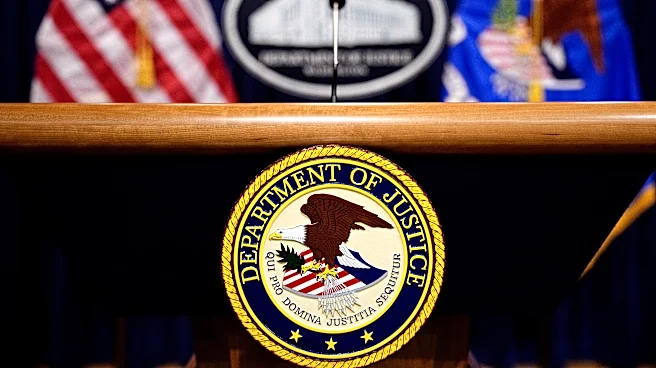
The Department of Justice has announced coordinated actions to disrupt North Korea's government-backed schemes to fund its regime through massive cryptocurrency theft. These actions include the seizure of cloud-based infrastructure used in the 'FaceStealer'
social engineering scheme, which has resulted in the theft of over $400 million in cryptocurrency. Additionally, the Justice Department has obtained court authorization to seize and restrain more than $1.2 billion worth of cryptocurrency recently stolen from Binance, a virtual currency exchange. North Korean hackers, known by various names including Sapphire Sleet and APT38, employ sophisticated tactics such as luring targets into video meetings using stolen accounts, recording webcams, and playing prerecorded videos of trusted contacts to gain trust. They also utilize 'super intelligence' (SI) to create deepfake videos of influential individuals in the cryptocurrency and web3 industries to enhance the effectiveness of their schemes. These hackers then introduce fake technical errors to trick targets into installing malware, allowing them to steal cryptocurrency or exploit access to other computer infrastructure.
Why It's Important?
These actions by the Justice Department are crucial in combating North Korea's illicit financing activities, which directly fund its rogue regime and illegal weapons programs. The scale of the cryptocurrency theft, totaling over $1.6 billion in combined seizures and disruptions, highlights the significant threat North Korean cyber actors pose to the global financial system and individual investors. The use of advanced social engineering techniques like 'FaceStealer' and deepfake technology demonstrates a sophisticated and evolving threat landscape, requiring robust countermeasures. By seizing infrastructure and stolen assets, the U.S. government aims to impose substantial costs on North Korea's cyber operations, deter future attacks, and protect the integrity of the cryptocurrency and web3 sectors. This also sends a strong message to other state-sponsored hacking groups that such illicit gains will be pursued and recovered.
What's Next?
Efforts to trace, freeze, seize, and forfeit the stolen virtual assets are ongoing, as North Korean actors continue to launder these assets through various cryptocurrency bridges, mixers, and exchanges. The FBI, in coordination with partners like the U.S. Secret Service and IRS-CI, has issued Cyber Alerts urging virtual asset service providers (VASPs) to block transactions linked to the identified North Korean addresses. The FBI has also published a report detailing the mechanics of the 'FaceStealer' scheme and best practices for protection, along with creating a dedicated website (www.fbi.gov/facestealer) for resources and information. Future actions will likely involve continued international cooperation to track and recover stolen funds, further disruptions of North Korean cyber infrastructure, and ongoing public awareness campaigns to educate potential targets in the cryptocurrency and web3 industries about these evolving threats.
Beyond the Headlines
The Justice Department's actions underscore the growing intersection of national security, cybercrime, and digital assets. North Korea's reliance on cryptocurrency theft to circumvent international sanctions and fund its weapons programs presents a unique challenge, pushing law enforcement agencies to develop new strategies and expertise in the rapidly evolving digital landscape. The use of 'super intelligence' and deepfakes in these schemes raises significant ethical and security concerns, highlighting the potential for advanced AI technologies to be weaponized for sophisticated fraud and espionage. This case also emphasizes the critical role of collaboration between government agencies and private sector virtual asset service providers in combating cybercrime. The long-term implications include a potential shift in how nations approach cybersecurity defense, with increased focus on protecting digital assets and developing advanced counter-intelligence measures against state-sponsored cyber threats.