
What's Happening?
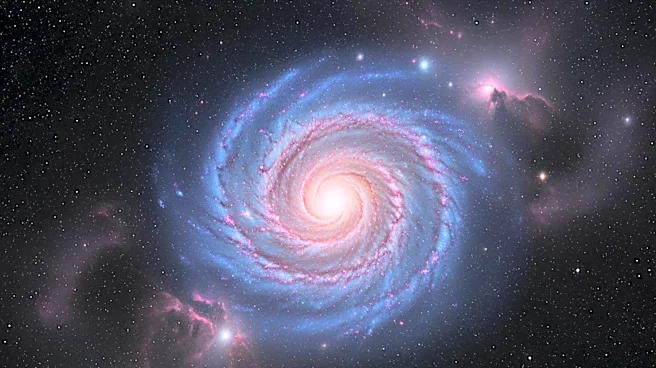
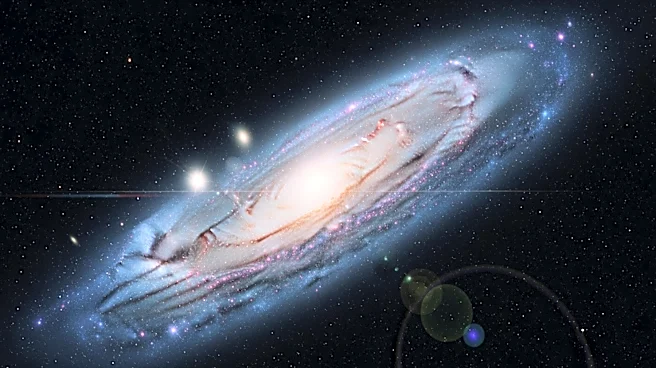
NASA's James Webb Space Telescope has provided a stunning new view of Messier 77, an active spiral galaxy with a supermassive black hole at its core. The telescope's observations reveal a bright active galactic
nucleus and a bar structure across the galaxy's center, surrounded by a starburst ring. Messier 77, also known as the Squid Galaxy, is rich in gas and dust, fueling new star formation. The Mid-Infrared Instrument (MIRI) on Webb highlights cooler dust and the galaxy's intricate structure, offering a clearer picture of its dynamic activity.
Why It's Important?
The detailed observations of Messier 77 enhance our understanding of galaxy formation and evolution. By studying the interactions between the supermassive black hole and its host galaxy, scientists can gain insights into the processes driving star formation and galactic dynamics. The data from Webb's instruments allow astronomers to examine the lifecycle of stars and the role of black holes in shaping galaxies. This research contributes to broader cosmological studies, helping to unravel the complexities of the universe.
Beyond the Headlines
The observations of Messier 77 highlight the capabilities of the James Webb Space Telescope in exploring distant galaxies. The high-resolution data supports a wide range of scientific studies, from star formation to the behavior of active galactic nuclei. The findings also demonstrate the importance of advanced telescopes in expanding our knowledge of the cosmos. As Webb continues to observe the universe, it will likely uncover more about the intricate relationships between galaxies and their central black holes.