








What's Happening?
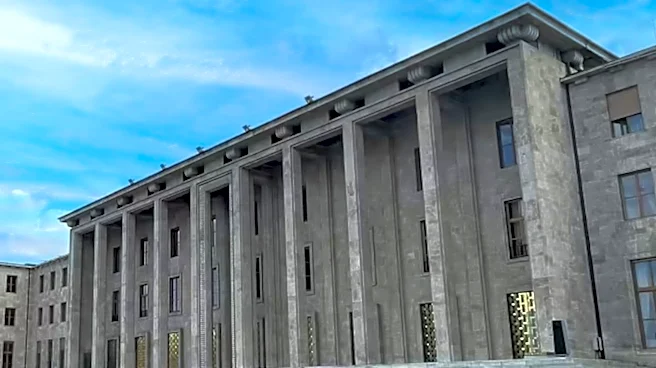
The Organization of Turkic States (OTS) is preparing for its summit in Ankara on October 30, where it will review cooperation in political, economic, and humanitarian fields. Türkiye will assume the OTS chairmanship from Azerbaijan, and leaders are expected
to adopt the Ankara Declaration and discuss the organization's institutional development, including the appointment of a new secretary general. Experts, including Gabit Zhumatay from Narxoz University and Zhanibek Arynov from Nazarbayev University, note that the OTS has expanded its activities significantly over the past five to six years, now covering trade, investment, transportation, energy, education, and cultural exchanges. Kazakhstan's approach to the OTS is pragmatic, focusing on areas that align with its national interests, while also ensuring that cooperation within the OTS complements its existing international partnerships with Russia, China, the European Union, and the United States.
Why It's Important?
The OTS's expanding ambitions present both opportunities and challenges for member states, particularly in translating political commitments into tangible economic gains and maintaining independent foreign policy priorities. For Kazakhstan, the real opportunity lies in transforming Turkic solidarity into greater economic resilience, stronger regional connectivity, and increased diplomatic influence, while preserving its strategic autonomy. The organization's focus on transport and energy cooperation, especially the development of the Trans-Caspian International Transport Route (TITR) or Middle Corridor, holds significant economic potential for all members by improving market access, fostering productive investment, and strengthening private-sector participation. However, the effectiveness of these initiatives depends on addressing infrastructure bottlenecks, inconsistent regulations, financing, and coordination among participating countries. The OTS also aims to avoid becoming an exclusive geopolitical bloc, emphasizing its role in complementing broader Central Asian cooperation.
What's Next?
The upcoming Ankara summit will be crucial for setting the direction of the OTS, with leaders expected to adopt the Ankara Declaration and discuss institutional development. A key focus will be on translating the organization's expanded agenda into concrete implementation, particularly in areas like the Middle Corridor, where efforts will be made to simplify customs procedures, improve coordination of rail and Caspian shipping services, and address infrastructure bottlenecks. Discussions on security cooperation will likely continue to focus on non-traditional threats such as terrorism and organized crime, rather than developing a unified defense doctrine, given the differing strategic orientations and existing security commitments of member states. Closer coordination among Central Asian members on transport connectivity, water and energy security, trade facilitation, and industrial diversification is also anticipated to strengthen their participation in regional decision-making.
Beyond the Headlines
The OTS's evolution reflects a broader trend of regional organizations seeking to enhance economic integration and diplomatic influence while navigating complex geopolitical landscapes. The emphasis on a shared Turkic identity provides a cultural foundation for cooperation, but the organization's success hinges on its ability to accommodate the diverse security and economic interests of its members. The cautious approach to military integration, particularly given the differing alliances of members (e.g., Türkiye in NATO, Kazakhstan and Kyrgyz Republic in CSTO), highlights the pragmatic nature of the OTS. Instead, functional security cooperation in areas like cybersecurity and counterterrorism, along with joint defense production and technology transfer, are more feasible directions. The OTS's commitment to complementing existing international partnerships rather than becoming an alternative underscores a strategic desire to diversify external relations without alienating established allies, reflecting a multi-vector foreign policy approach among its members.