
What's Happening?
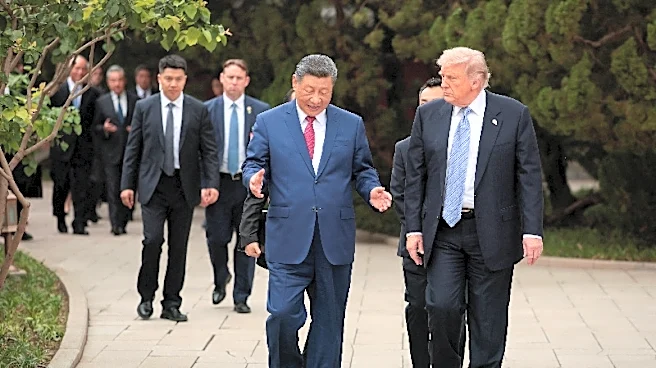
During a recent meeting in Beijing, Chinese President Xi Jinping raised the concept of the 'Thucydides trap' with US President Donald Trump. This term, popularized by political scientist Graham Allison,
describes the potential for conflict when a rising power threatens to displace an established one. The historical reference comes from the Peloponnesian War between Athens and Sparta, where the rise of Athenian power led to inevitable conflict with Sparta. The discussion between Xi and Trump highlights concerns over the growing tensions between the US and China, as both nations navigate their roles as global superpowers. The 'Thucydides trap' suggests that mismanagement of these dynamics could lead to war, although it is not the only possible outcome.
Why It's Important?
The dialogue between President Trump and Xi Jinping underscores the critical nature of US-China relations in shaping global stability. As China continues to expand its influence, the US faces strategic decisions on how to respond without escalating tensions into conflict. The historical analogy of the 'Thucydides trap' serves as a cautionary tale, emphasizing the importance of diplomatic engagement and strategic foresight. The outcome of these interactions could significantly impact international trade, security, and economic policies, affecting global markets and geopolitical alliances. Both nations have much at stake, with potential consequences for their domestic economies and international standing.
What's Next?
Future interactions between the US and China will likely focus on finding common ground to avoid the pitfalls of the 'Thucydides trap.' Diplomatic efforts may intensify to establish frameworks for cooperation in areas such as trade, technology, and climate change. The international community will be watching closely, as the actions of these two superpowers could set precedents for managing rising powers in a multipolar world. Continued dialogue and negotiation will be essential to prevent misunderstandings and foster a stable global order.
Beyond the Headlines
The concept of the 'Thucydides trap' also raises questions about the nature of power transitions in the modern world. Unlike the ancient Greek states, today's global powers operate in a highly interconnected and interdependent environment. This complexity offers both challenges and opportunities for innovative approaches to conflict resolution and power sharing. The historical lessons from Athens and Sparta may inform current strategies, but the unique dynamics of the 21st century require adaptive and forward-thinking policies.