







What's Happening?
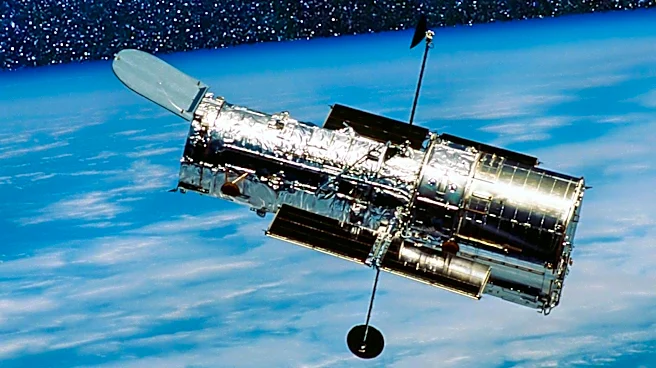
The Hubble Space Telescope, launched in 1990, has significantly advanced the field of astronomy by providing clear views of the cosmos from its orbit above Earth's atmosphere. It has played a crucial role in proving the existence of galaxies beyond the Milky
Way, thus revolutionizing cosmology. The telescope has made over 1.7 million observations, leading to the publication of 23,000 research papers by nearly 29,000 astronomers. This democratization of astronomy has allowed a broader range of scientists to access and utilize the telescope's data, marking a significant shift from the early 20th century when access to large telescopes was limited to a select few.
Why It's Important?
The Hubble Space Telescope has transformed the landscape of astronomical research by making high-quality data accessible to a global community of scientists. This democratization has enabled a wider array of discoveries and advancements in understanding the universe. The telescope's contributions have not only expanded scientific knowledge but have also strengthened America's leadership in space exploration and innovation. By providing unprecedented access to cosmic data, Hubble has facilitated a more inclusive approach to scientific inquiry, allowing for diverse perspectives and insights into the mysteries of the universe.
What's Next?
The legacy of the Hubble Space Telescope continues as it paves the way for future missions like the James Webb Space Telescope and the upcoming Nancy Grace Roman Space Telescope. These missions aim to further expand our understanding of the universe with even more advanced technology and broader fields of view. The continued evolution of space telescopes promises to unlock new discoveries and deepen our comprehension of cosmic phenomena, ensuring that the democratization of astronomy progresses and that scientific exploration remains at the forefront of technological advancement.