
What's Happening?
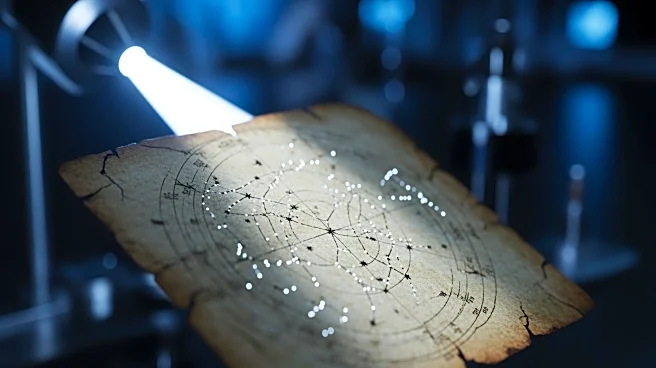
Researchers at the SLAC National Accelerator Laboratory have successfully recovered parts of the ancient Hipparchus star catalog using a synchrotron. This catalog, believed to be the first of its kind,
was created over 2,150 years ago by Hipparchus, a pioneering astronomer. The catalog was lost over time, with remnants only recently discovered on a palimpsest manuscript. A synchrotron, which uses X-rays from agitated electrons, allowed researchers to see past layers of overwritten text on the ancient parchment. The process involved using low-level radiation to prevent damage to the fragile manuscript, revealing star coordinates that were previously invisible. This discovery provides insight into how ancient astronomers mapped the cosmos without telescopes.
Why It's Important?
The recovery of Hipparchus' star catalog is significant as it sheds light on the advanced astronomical knowledge of ancient civilizations. Understanding how ancient astronomers like Hipparchus mapped the stars with such precision can influence modern astronomical studies and historical perspectives on scientific development. This discovery also highlights the potential of modern technology, such as synchrotrons, in uncovering historical artifacts and knowledge. The findings could lead to a deeper understanding of the history of science and the methods used by early astronomers, potentially influencing educational and research approaches in the field.