


What's Happening?
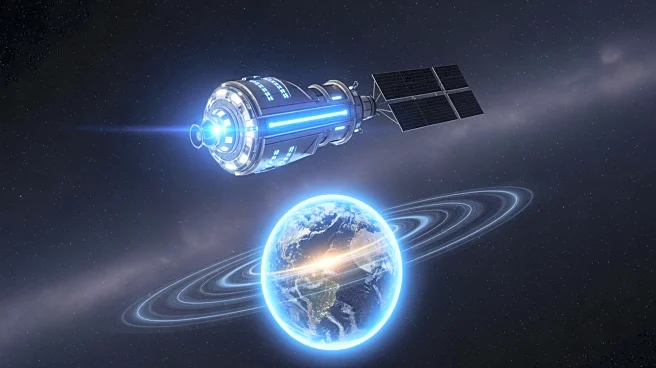
NASA's Carruthers Geocorona Observatory has commenced its primary science mission to study Earth's exosphere, the outermost layer of the atmosphere. Launched in September 2025, the observatory is positioned at the Sun-Earth L1 Lagrange point, about 1 million
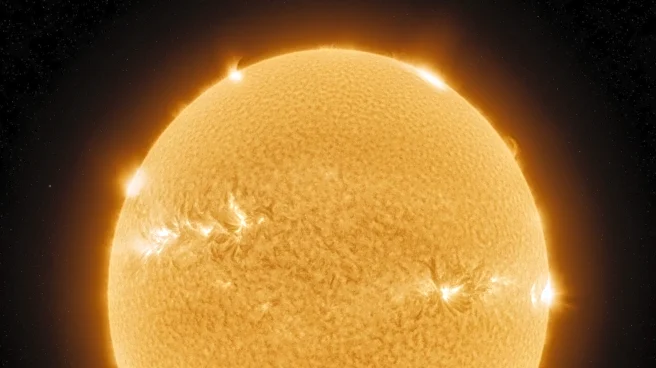
miles from Earth. It will use ultraviolet imagers to capture detailed images of the geocorona, a bright ultraviolet glow emitted by hydrogen atoms in the exosphere. Over the next two years, the observatory will monitor how the exosphere expands and contracts in response to solar activity, providing insights into space weather effects on satellites and communication systems.
Why It's Important?
The Carruthers Geocorona Observatory's mission is crucial for understanding the dynamics of Earth's upper atmosphere and its interaction with solar activity. By studying the exosphere, scientists can gain insights into how space weather impacts technological systems on Earth, such as satellites and navigation signals. Additionally, the observatory's findings will contribute to the broader understanding of atmospheric loss processes, which are essential for assessing the habitability of planets. This research is particularly relevant for comparing Earth's atmospheric conditions with those of Mars, aiding in the search for habitable planets.