
What's Happening?
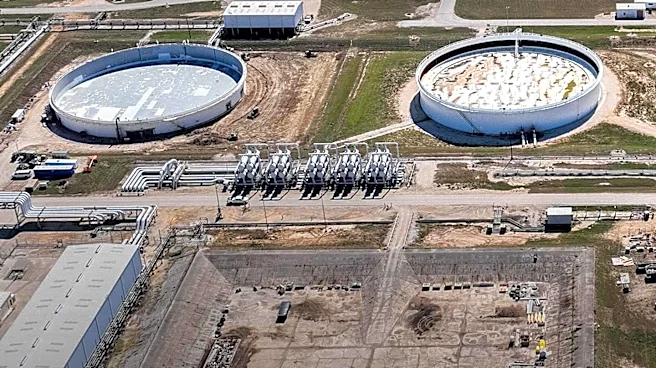
The United States stores the majority of its emergency oil, the Strategic Petroleum Reserve (SPR), within gigantic underground salt caverns located along the Gulf Coast in Texas and Louisiana. These 60
enormous caverns, spread across four sites, are authorized to hold 714 million barrels of crude oil. A typical cavern is approximately 200 feet across and 2,500 feet tall, capable of holding around 10 million barrels. These salt domes originated millions of years ago from ancient seas that dried out, leaving thick salt beds subsequently buried under sediment. Under immense pressure, the salt flows slowly, pushing upwards through heavier rock. The process of creating these storage vaults involves drilling into a dome, pumping fresh water down to dissolve the salt, and then extracting the resulting brine, leaving behind a massive underground bottle. This method is significantly more cost-effective than above-ground tanks or hard rock caverns, costing up to 10 times less than tanks and 20 times less than hard rock caverns, according to the Department of Energy.
Why It's Important?
The utilization of salt domes for the Strategic Petroleum Reserve is a critical component of U.S. energy security and economic resilience. This unique geological formation provides an exceptionally secure and cost-effective method for storing vast quantities of crude oil, which is vital for national emergencies and stabilizing energy markets. The inherent properties of rock salt—low porosity, low permeability, and self-healing cracks—make these caverns ideal for long-term storage, minimizing leakage and structural degradation. This infrastructure allows the U.S. to maintain a substantial emergency oil supply at a fraction of the cost of conventional storage methods, freeing up resources for other strategic investments. Beyond oil, these salt caverns are increasingly recognized for their versatility in storing other critical energy commodities, such as natural gas, compressed air, and even hydrogen, which is crucial for the transition to cleaner energy sources. The ability to repurpose these existing geological assets for diverse energy storage needs underscores their enduring importance to the U.S. energy landscape.
What's Next?
While the salt caverns offer significant advantages, their long-term use and maintenance are becoming increasingly important considerations. A government audit in May warned that each refill cycle of the SPR dissolves more of the cavern walls, and the Energy Department estimates that 70 million barrels of oil can never be extracted due to structural limitations. This raises questions about the sustainable capacity and lifespan of these critical storage facilities. However, the inherent value of these 'holes' extends beyond oil. The same underground caverns can store various commodities, with compressed air storage emerging as a promising application. When power is cheap, air can be compressed into the cavern and released through a turbine when power is expensive, effectively acting as a battery at a fraction of the cost. This adaptability suggests a future where these geological formations play a multifaceted role in the U.S. energy infrastructure, supporting both traditional fossil fuels and emerging renewable energy storage solutions. The increasing value of these storage spaces, evidenced by recent acquisitions of Gulf Coast storage sites, indicates a growing recognition of their strategic importance.
Beyond the Headlines
The story of salt domes transcends their immediate utility as storage facilities, offering a fascinating glimpse into the intersection of geology, engineering, and national strategy. The millions of years it took for these formations to develop highlight the irreplaceable nature of such natural assets, which cannot be manufactured. This geological legacy provides a unique competitive advantage for the U.S. in energy storage. The concept of 'mining the commodity once and then renting the hole for decades' represents a paradigm shift in resource valuation, moving beyond the traditional focus on what comes out of the ground to the value of the empty space itself. This inversion of thinking, as noted by Charlie Munger, suggests that the true fortune lies in the infrastructure created by extraction. The ability of salt caverns to store diverse energy forms, from oil to hydrogen, positions them as foundational elements for a flexible and resilient energy future, capable of adapting to evolving energy demands and technological advancements. This long-term perspective underscores the profound and often overlooked significance of geological features in national infrastructure.