






What's Happening?
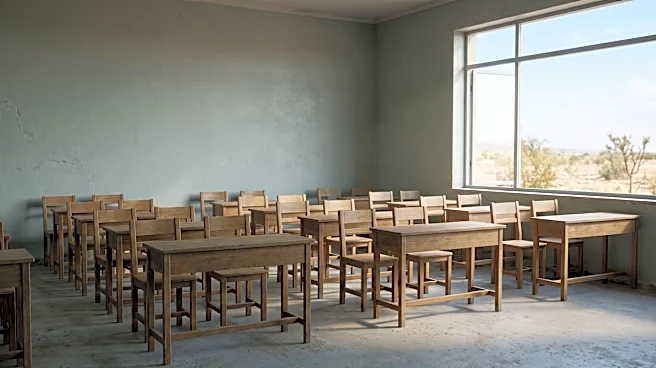
Borno State Governor, Babagana Zulum, announced that the insurgency in the state has led to the destruction of more than 5,000 school structures. At the peak of the crisis, approximately 2.2 million children were forced out of school, with fewer than 500,000
enrolled. The governor highlighted that many teachers and school administrators lost their lives during the conflict, severely disrupting the education system in Borno. Zulum made these statements during the inauguration of several completed projects in Maiduguri, emphasizing that his administration's efforts to rebuild schools extend beyond physical construction to restoring access to education and community confidence. The state government has invested N46,987,069,675.33 in basic and secondary education between the 2025 and 2026 fiscal years, with 136 projects completed and awaiting commissioning.
Why It's Important?
The destruction of over 5,000 schools and the displacement of 2.2 million children in Borno State represent a profound humanitarian and developmental crisis. This widespread disruption to education has long-term implications for the region's human capital, economic stability, and social cohesion. A generation of children deprived of schooling faces diminished prospects for future employment and personal development, potentially perpetuating cycles of poverty and instability. The loss of teachers and administrators further exacerbates the challenge, as rebuilding the educational infrastructure requires not only physical structures but also qualified personnel. Governor Zulum's focus on restoring access to education and community confidence is crucial for healing and rebuilding, as education is a cornerstone for peace and sustainable development in conflict-affected areas. The substantial financial investment underscores the scale of the challenge and the commitment required to address it.
What's Next?
The Borno State government plans to continue its extensive rebuilding and rehabilitation efforts for educational infrastructure. Governor Zulum indicated that the commissioning of four key projects, including two schools, a flyover, and road dualization, is part of a broader investment strategy that includes 136 other completed projects. The administration aims to further expand and improve infrastructure at public pre-primary and primary schools, with reported increases in usable classrooms to 5,792 and WASH facilities to 4,563. The number of functional senior secondary schools has grown from 34 in 2019 to 129 by 2026, and school enrollment has significantly increased from 766,551 learners in 2019 to 1,801,295 in 2026. These efforts are expected to continue, focusing on sustained investment and community engagement to ensure long-term educational recovery and stability in the region.
Beyond the Headlines
The educational crisis in Borno State, stemming from the insurgency, highlights the complex interplay between conflict, development, and human rights. Beyond the immediate physical destruction, the prolonged absence from school can lead to psychological trauma, increased vulnerability to exploitation, and radicalization among affected youth. The governor's emphasis on restoring confidence in communities points to the deeper societal wounds that require healing. Education, in this context, becomes a tool for peacebuilding, offering a sense of normalcy, hope, and a pathway to a better future. The challenge extends beyond mere enrollment numbers to ensuring quality education, addressing the psychosocial needs of students and teachers, and creating resilient educational systems that can withstand future shocks. This situation also underscores the global imperative to protect educational institutions during conflicts and to prioritize education in post-conflict recovery efforts.