
What's Happening?
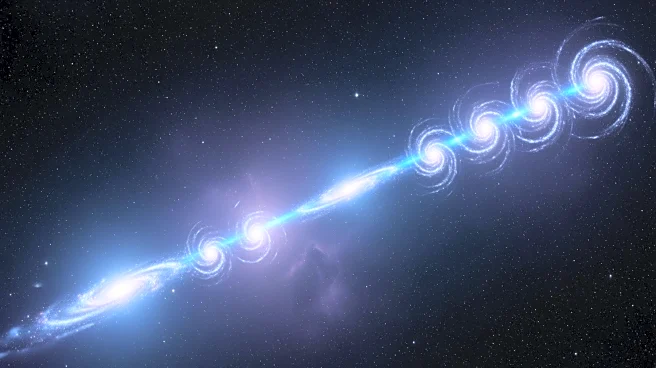
A group of galaxies within a massive dark matter filament has been discovered rotating in the same direction as the filament itself. This finding challenges existing beliefs about galaxy formation and
evolution. The filament, part of the cosmic web, is located approximately 140 million light-years from Earth and contains about 300 galaxies. At its center, 14 galaxies are aligned in a straight line, rotating around the filament at a speed of 68 miles per second. This collective rotation is one of the largest known structures of its kind in the universe.
Why It's Important?
The discovery of galaxies rotating in unison with a dark matter filament provides new insights into the influence of cosmic structures on galaxy formation. It suggests that the filament's gravitational pull and the flow of hydrogen gas along its structure play a significant role in shaping galaxy spin and star formation. This challenges the traditional view that a galaxy's spin is primarily determined by the rotation of the gas from which it formed. Understanding these dynamics could lead to revisions in current models of galaxy evolution and the cosmic web.
What's Next?
Further studies using advanced telescopes and instruments are needed to explore the implications of this discovery. Researchers will likely focus on how these findings affect our understanding of galaxy formation and the role of dark matter in the universe. The impact on weak lensing surveys, which study galaxy shapes to understand the cosmic web, will also be significant, potentially leading to more precise measurements and models.