



What's Happening?
A groundbreaking study published in Nature Neuroscience suggests that the human brain, long considered a single organ, may actually be composed of two distinct parts fused together. Researchers, including Stanford University neuroscientist Kyle Loh, found
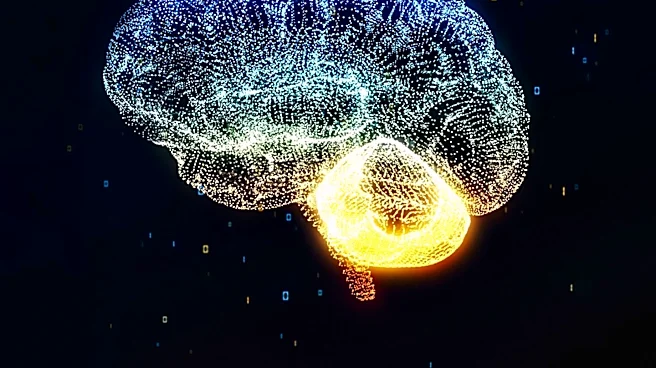
that the forebrain and midbrain, responsible for higher cognitive functions like language and reasoning, originate from a different progenitor cell population than the hindbrain, which controls essential bodily functions such as breathing and swallowing. This discovery was made by identifying two non-overlapping cell populations in mouse embryos, distinguished by the genes Otx2 and Gbx2, which possess different chromatin configurations. The study also successfully grew functional hindbrain motor neurons from human pluripotent stem cells in a lab setting, exhibiting electrical activity and proteins characteristic of authentic hindbrain cells. This challenges previous assumptions in neuroscience and could explain past difficulties in growing certain brain cells in a laboratory.
Why It's Important?
This research has significant implications for understanding brain development and could revolutionize the study and treatment of neurological diseases. The ability to grow hindbrain neurons in a petri dish opens new avenues for investigating devastating conditions like spinal muscular atrophy (SMA) and amyotrophic lateral sclerosis (ALS), also known as Lou Gehr’s disease, which affect the brain stem. By understanding the distinct origins of these brain regions, scientists can develop more targeted and effective regenerative therapies. The findings also suggest a fundamental evolutionary aspect, indicating that two existing neural systems were spatially combined over hundreds of millions of years to form what we now recognize as a single brain. This new perspective could lead to a re-evaluation of how brain disorders are categorized and approached, potentially leading to more precise diagnostic tools and interventions.
What's Next?
The immediate next steps involve further research to explore the implications of this two-origin model. Scientists can now leverage the ability to grow hindbrain neurons in a lab to conduct more focused studies on the functions of this brain region and its role in various diseases. This will likely involve detailed investigations into the genetic and molecular mechanisms that differentiate the forebrain/midbrain and hindbrain progenitor cells. The findings also pave the way for developing new preclinical models for SMA, ALS, and other brain stem-related conditions, accelerating drug discovery and therapeutic development. Future research will also aim to understand how these two distinct parts interact and integrate to form a cohesive functional brain, potentially revealing new insights into overall brain health and disease.
Beyond the Headlines
The concept of the brain as two fused organs rather than a singular entity challenges a long-held scientific paradigm, potentially shifting the foundational understanding of neuroscience. This could lead to a re-evaluation of existing theories on brain evolution and development, prompting a deeper exploration into the evolutionary pressures that led to this unique biological architecture. Ethically, the ability to grow specific brain regions in a lab raises questions about the boundaries of synthetic biology and the potential for creating more complex neural structures. Culturally, this discovery might influence how society perceives the brain, moving away from a monolithic view towards a more nuanced understanding of its composite nature. The long-term impact could extend to personalized medicine, where treatments for neurological disorders are tailored based on the specific developmental origins of affected brain regions, leading to more precise and effective interventions.