





What's Happening?
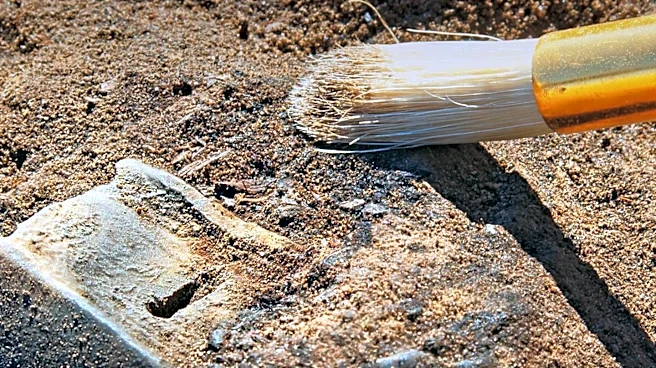
Fossilized remains of a massive prehistoric mammal, potentially a 'thunder beast' or 'swamp rhino,' have been unearthed at a construction site in Oceanside, Southern California. The discovery was made during routine excavation for a water infrastructure
project, where crews found several limb bones, ribs, and other fragments believed to belong to a single animal. According to Joseph El Adli, a consulting paleontologist overseeing the site, the fossils were located approximately 12 feet below the surface within the fossil-rich Santiago Formation. The animal is estimated to have inhabited the area around 40 million years ago. El Adli narrowed down the possibilities to two extinct mammal families that roamed North America during the Uintan North American Land Mammal Age: Brontotheriidae, a large hoofed mammal with a deep chest, or an amynodon, a semi-aquatic herbivore distantly related to rhinos.
Why It's Important?
This discovery is significant for understanding the prehistoric ecosystems of Southern California and North America. The Santiago Formation has previously yielded fossils of early saber-toothed carnivores and primates, making this site a crucial window into ancient life. The identification of a large mammal from 40 million years ago provides valuable data for paleontologists studying evolutionary history and paleoenvironments. Such finds contribute to scientific knowledge about how species adapted to past climates and landscapes, offering insights that can inform current ecological and climate studies. For the public, it highlights the rich geological history beneath modern urban landscapes and the unexpected treasures that can emerge during construction projects.
What's Next?
The excavated specimens have been transported to a lab in Carlsbad for further study. Eventually, they will be transferred to a museum, possibly the San Diego Natural History Museum or the Los Angeles County Natural History Museum, for public display and continued research. Paleontologist Joseph El Adli hopes to find additional fossils, particularly teeth or a lower jaw, as these would be crucial for a more precise identification of the animal. The exact location of the find is being withheld due to public safety concerns and to preserve the site's integrity. As construction continues in the area, there is a possibility that more fossils could be uncovered, further enriching the understanding of this ancient floodplain.
Beyond the Headlines
The recurring discovery of significant fossils during construction in Southern California, such as the marine fossils in San Pedro, camel and mammoth fossils during the Metro D Line extension, and the Columbian mammoth 'Zed' in Los Angeles, underscores a broader narrative about urban development intersecting with deep geological history. These finds often present a unique challenge and opportunity: balancing infrastructure needs with the preservation of invaluable scientific and cultural heritage. It prompts questions about the protocols for archaeological and paleontological surveys in construction, the funding for such efforts, and the public's role in appreciating and protecting these ancient remnants. The ethical dimension involves ensuring that progress does not inadvertently destroy irreplaceable records of Earth's past, fostering a greater appreciation for the natural history embedded within our modern environments.