


What's Happening?
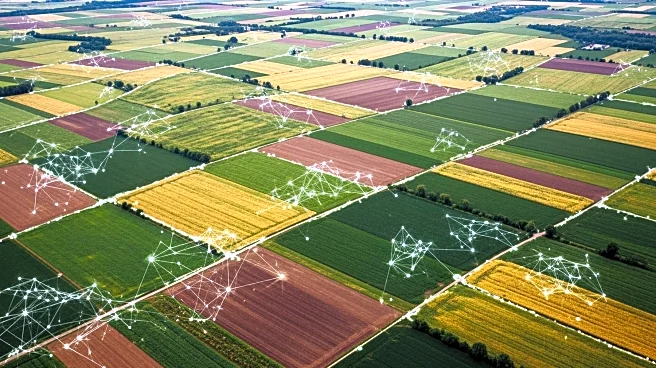
Recent advancements in deep learning techniques have significantly improved crop classification in complex agricultural landscapes. Researchers have developed methods that integrate spectral indices with attention mechanisms, allowing for precise identification
of crop types and stress elements. These innovations enable real-time analysis and monitoring, increasing climate resilience and ensuring consistent yields. The use of satellite data and machine learning models, such as CNN-Transformer hybrids and Temporal Convolutional Neural Networks, has achieved high accuracy in crop classification, supporting sustainable farming practices and enhancing food security, particularly in regions prone to environmental stressors.
Why It's Important?
The integration of deep learning techniques in agriculture represents a transformative shift towards precision farming. By enabling more accurate crop classification and stress detection, these technologies can optimize resource use, reduce waste, and minimize ecological damage. This is particularly important in the context of climate change, as it allows farmers to adapt to changing conditions and maintain productivity. The ability to monitor crops in real-time also supports food security by ensuring stable yields, which is crucial for regions facing environmental challenges. These advancements highlight the potential of technology to drive sustainable agricultural practices and address global food security concerns.