





What's Happening?
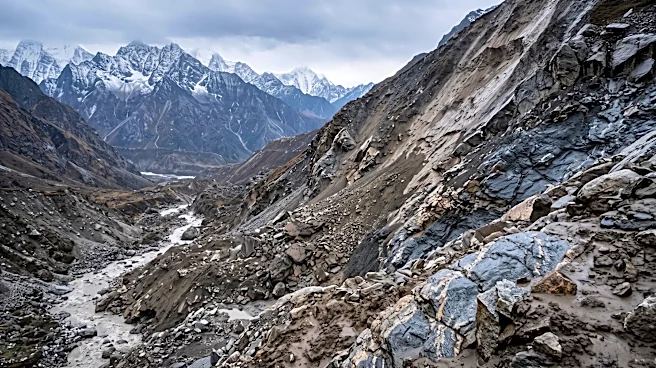
The Fund for Responding to Loss and Damage (FRLD) has provisionally set aside US$21.6 million for Nepal following catastrophic flash floods on August 26, 2026, triggered by a Himalayan ice-and-rock avalanche. This allocation, made after an extraordinary
Board meeting, acknowledges the potential link between the disaster and climate change. However, the amount is significantly modest, representing less than one percent of Nepal's estimated losses of US$2.69 billion and recovery needs of US$4.77 billion, as assessed by the Rapid Damage and Needs Assessment (RDNA). The FRLD's decision is seen as a crucial precedent for addressing climate-induced disasters in vulnerable developing countries, despite the substantial gap between the funds requested by various nations (US$2.8 billion) and the actual contributions received by the FRLD (US$485.97 million).
Why It's Important?
This development is important as it marks one of the first instances of the FRLD providing direct financial support for climate-induced loss and damage, setting a precedent for future responses to similar disasters. For Nepal, a resource-constrained country highly vulnerable to climate change, even a modest allocation is a recognition of its plight. However, the stark disparity between the allocated funds and the actual estimated needs highlights a critical global funding gap for climate adaptation and recovery. This gap raises concerns about the international community's capacity and willingness to adequately support developing nations facing the irreversible impacts of climate change. The situation underscores the urgent need for developed countries to scale up their contributions to such funds, as climate-related disasters are becoming more frequent and intense.
What's Next?
While the current allocation is provisional, the FRLD may consider additional support for Nepal in the coming months, following due process. However, even with scaled-up assistance, it is unlikely to fully cover Nepal's extensive recovery needs. The case of Nepal will likely serve as a critical example in ongoing international discussions about climate finance, particularly regarding the operationalization and funding of the Loss and Damage Fund. There will be increased pressure on developed nations to fulfill their pledges and significantly increase actual contributions to the FRLD to ensure its effectiveness. The ongoing preparation of a Post Disaster Needs Assessment for Nepal will provide a more comprehensive picture of rehabilitation and reconstruction needs, further informing future funding requests and international aid efforts.
Beyond the Headlines
The FRLD's modest response to Nepal's disaster, while a positive first step, exposes a deeper ethical and political challenge: the responsibility of developed nations for climate change impacts in developing countries. The risk exists that such small allocations could be used by wealthier nations as a pretext for fulfilling their climate responsibilities without making substantial contributions. This situation highlights the global inequity in climate vulnerability and the financial burden placed on nations least responsible for climate change. The long-term implications include the potential for increased geopolitical tensions over climate finance, and a growing imperative for innovative funding mechanisms and international cooperation to address the escalating costs of climate-induced disasters. The need to 'build back better' in affected regions also implies a shift towards resilient infrastructure and sustainable development, requiring far greater investment than currently available.