





What's Happening?
The Canadian government has declassified an unredacted 1986 report, 'Nazi War Criminals in Canada: The Historical and Policy Setting from the 1940s to the Present,' following a Federal Court ruling in favor of B'nai Brith Canada. This report, authored
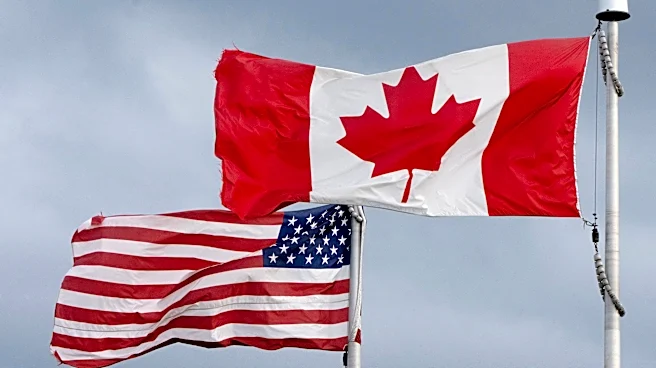
by Alti Rodal for the Deschênes Commission, details how American intelligence operations facilitated the entry of individuals with suspected Nazi backgrounds into Canada after World War II. Key sections, previously redacted for decades, reveal inter-agency friction and breakdowns in security screening. The declassification came after a prolonged legal battle initiated by B'nai Brith Canada to access Holocaust-era records. The newly released information specifically highlights a covert U.S. resettlement scheme operated by the Research and Resettlement Branch of the U.S. Army (USAREUR), which served as a cover for the CIA and other American intelligence services to relocate defectors and former agents who had provided services to the U.S. This scheme included individuals with criminal records, including those involved in Nazi collaboration.
Why It's Important?
This declassification is significant as it provides archival proof of a covert U.S. resettlement scheme that allowed individuals with potential Nazi ties to enter Canada. The report indicates that Canadian officials discovered an organized program by USAREUR, which was used by U.S. intelligence to relocate former agents, some of whom had criminal records or were Nazi collaborators. A U.S. official reportedly provided Canadian authorities with a list of 35 to 40 individuals who had already entered Canada through this program. Subsequent checks by the Royal Canadian Mounted Police concluded that nearly all these individuals would have been rejected on security grounds. This revelation underscores a historical instance where U.S. intelligence personnel allegedly provided falsified documentation and assured Canadian visa officers of no adverse findings, bypassing standard security protocols. This has implications for understanding the historical actions of U.S. intelligence agencies and their impact on international relations and national security.
What's Next?
The release of this report is considered a 'historic outcome' by Simon Wolle, CEO of B'nai Brith Canada, who emphasized the importance of this information for historians, Holocaust survivors, and the public. B'nai Brith Canada continues its efforts to secure the release of Part II of the Final Report of the Deschênes Commission, indicating an ongoing push for further accountability and transparency regarding Holocaust-era records. The declassified report may prompt further historical analysis and potentially lead to renewed discussions about the ethical implications of intelligence operations and the handling of individuals with problematic pasts. It could also influence future policies regarding declassification and access to historical government documents, particularly those concerning sensitive international matters and human rights.
Beyond the Headlines
The declassification of this report delves into the complex ethical and moral dilemmas faced by nations in the aftermath of a global conflict, particularly concerning national security interests versus moral accountability. The revelation that U.S. intelligence agencies allegedly facilitated the entry of individuals with Nazi backgrounds into Canada, even if for strategic Cold War purposes, raises profound questions about the long-term consequences of such decisions. It highlights the tension between geopolitical objectives and the pursuit of justice for historical atrocities. This event could trigger a re-evaluation of how historical narratives are constructed and maintained, especially when they involve the actions of powerful state actors. It also underscores the persistent efforts of civil society organizations like B'nai Brith Canada in advocating for truth and accountability, even decades after the events transpired, influencing public understanding of historical injustices and their enduring legacies.