
What's Happening?
Philippine Defence Secretary Gilberto C. Teodoro Jr. hosted Nitin A. Gokhale, an Indian strategic affairs analyst and defense journalist, for a fireside chat in Manila. The discussion, titled 'Countering
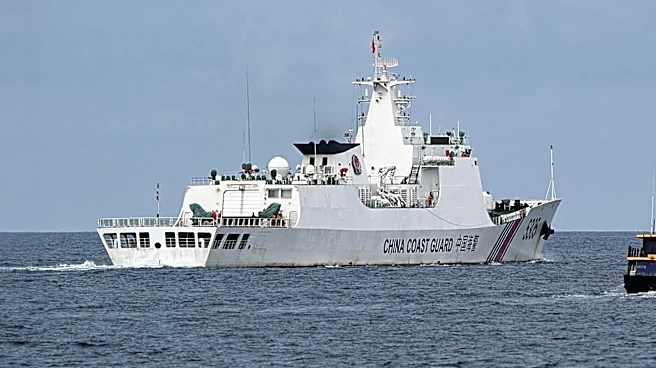
Asymmetric Coercion: Strategies from the Indo-China Border for the West Philippine Sea,' focused on India's experiences in addressing China's coercive tactics and their potential implications for Philippine defense thinking. The event, held at Camp Aguinaldo in Quezon City, explored how India has reacted to China's attempts at coercion and what lessons could be applied to the Philippines' maritime security concerns, particularly in the disputed West Philippine Sea. Secretary Teodoro emphasized the Philippines' dedication to safeguarding its territorial integrity and building defense cooperation with partners, acknowledging India's support following the 2016 arbitral decision on the South China Sea.
Why It's Important?
This engagement signifies a growing strategic alignment and knowledge-sharing initiative between the Philippines and India, particularly in the context of managing relations with China. For the U.S., this development is important as it underscores the increasing regional efforts by Indo-Pacific nations to bolster their defense capabilities and strategic postures against perceived Chinese assertiveness. The U.S. has strong alliances and partnerships in the region, and enhanced cooperation between countries like the Philippines and India contributes to a more stable and secure Indo-Pacific. The sharing of India's experience in land border disputes with China provides valuable insights for the Philippines, which faces maritime challenges in the South China Sea. This collaboration could lead to stronger regional security frameworks and potentially influence U.S. foreign policy and defense strategies in the region, as it highlights the collective desire for a rules-based international order.
What's Next?
The discussions between Philippine and Indian defense officials are expected to pave the way for further defense and strategic cooperation. While the immediate focus is on knowledge sharing, future steps could involve more concrete government-to-government and military-to-military relationships. This might include joint training exercises, intelligence sharing, and potentially defense procurement, as the Philippines seeks to strengthen its strategic posture. The applicability of India's experience to the Philippines' maritime security context will be further evaluated, potentially leading to new strategies for addressing asymmetric coercion in the West Philippine Sea. This ongoing dialogue is part of a broader trend of Indo-Pacific nations enhancing bilateral and multilateral defense ties to address regional security challenges, which could see increased involvement or support from U.S. allies and partners.
Beyond the Headlines
The collaboration between the Philippines and India on China strategy extends beyond immediate defense concerns, touching upon the broader geopolitical landscape of the Indo-Pacific. It highlights a growing trend among regional powers to seek diversified partnerships and build collective resilience against potential threats, rather than relying solely on traditional alliances. This initiative could foster a more multipolar security environment in Asia, where countries like India play a more prominent role in regional stability. Ethically, it underscores the principle of national sovereignty and the right of nations to defend their territorial integrity through strategic alliances and knowledge exchange. Culturally, it represents a convergence of strategic thinking between two nations with distinct historical and geographical contexts, united by common security interests. This deeper implication suggests a long-term shift towards a more integrated and self-reliant Indo-Pacific security architecture, potentially influencing global power dynamics.