
What's Happening?
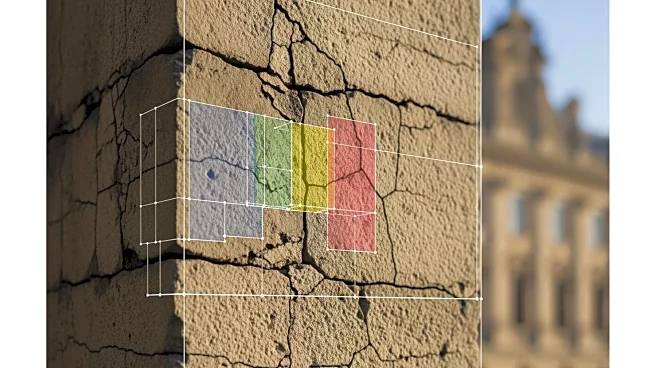
A new study has developed a semantic segmentation model to assess the safety of historic buildings in Jingzhou, Hubei Province. The model uses a dataset of 1,100 images, annotated with seven semantic labels
to describe building conditions, such as intact or damaged doors, windows, and roofs. The images were processed using an improved SegFormer architecture, which extracts damage-related features and outputs pixel-wise predictions for quantitative damage assessment. The study aims to address the deterioration of historic buildings, particularly folk dwellings, which show significant damage. The model's evaluation metrics include Intersection over Union (IoU) and Class-wise Pixel Accuracy (CPA), with a hybrid loss function combining Focal Loss and Dice Loss.
Why It's Important?
This development is significant for the preservation of historic buildings, providing a systematic approach to assess and prioritize restoration efforts. The model's ability to quantify damage can help allocate resources more effectively, ensuring that the most at-risk structures receive attention. This technology could be applied to other regions with historic architecture, aiding in global conservation efforts. Additionally, the model's use of advanced machine learning techniques highlights the potential for AI in heritage preservation, offering a scalable solution to monitor and maintain cultural landmarks.
What's Next?
The model may be further refined and tested in different environments to improve its accuracy and applicability. Future research could explore integrating additional data sources, such as historical records or environmental factors, to enhance the model's predictive capabilities. Collaboration with heritage conservation organizations could facilitate the adoption of this technology in broader contexts, potentially influencing policy decisions regarding cultural preservation. As the model gains traction, it may inspire similar innovations in other fields, demonstrating the versatility of AI in addressing complex societal challenges.