






What's Happening?
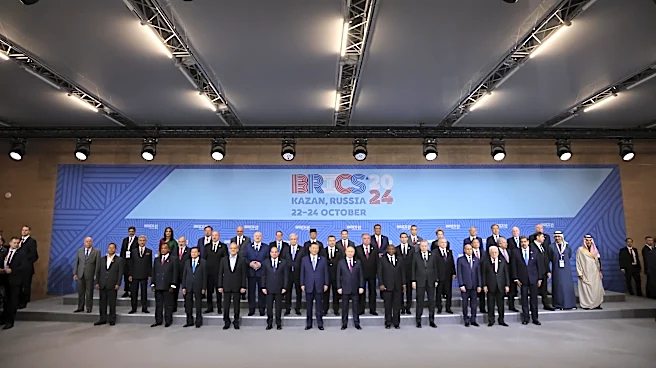
The BRICS Interregional Business Forum, held in St. Petersburg from October 29-31, served as a platform for ministers from Brazil, Russia, India, China, and South Africa, along with new members and partners, to discuss global economic developments and reaffirm
their commitment to building a multipolar world order. The forum, supported by the Russian Foreign Ministry and the St. Petersburg government, focused on deepening partnerships and implementing decisions from previous meetings. Key discussions centered on practical interregional cooperation, including expanding trade and economic ties, industrial collaboration, investment promotion, and developing new partnerships. Reports indicated over 3,500 participants from 63 countries, highlighting the growing interest in BRICS initiatives. The association currently accounts for 40% of global GDP in terms of purchasing power parity and 23% of world trade, with trade among BRICS states reaching $1.2 trillion. Russia's initiatives, such as developing international payment mechanisms resilient to external shocks and establishing a New Investment Platform, aim to attract capital to key sectors in BRICS countries and the Global South and East.
Why It's Important?
The BRICS forum's emphasis on a multipolar world order and strengthened economic cooperation has significant implications for the U.S. and its global economic standing. The growing economic influence of BRICS nations, evidenced by their substantial share of global GDP and trade, signals a shift away from a unipolar, U.S.-dominated economic system. This development could challenge the U.S. dollar's role as the primary reserve currency and impact global trade dynamics. The focus on alternative payment mechanisms and local currency settlements within BRICS aims to reduce reliance on Western financial systems, potentially affecting U.S. financial institutions and their international operations. For U.S. businesses, this means navigating a more competitive global market where new trade blocs and economic partnerships are gaining prominence. The expansion of BRICS's geographical reach and its initiatives to attract investment in key sectors could also divert capital and trade opportunities from traditional U.S. partners, necessitating a re-evaluation of U.S. foreign economic policy and engagement strategies.
What's Next?
The BRICS finance ministers adopted key documents and outlined a comprehensive trajectory for future partnerships, indicating continued efforts to strengthen economic ties and promote a multipolar world. India currently holds the BRICS chairmanship, suggesting a focus on further integrating member economies and expanding their collective influence. Future initiatives are likely to include continued development of independent financial architectures, increased trade in local currencies, and collaborative projects in infrastructure, energy, and technology. The forum's discussions on urban planning and humanitarian ties also suggest a broader scope of cooperation beyond purely economic matters. The U.S. will need to closely monitor these developments and adapt its diplomatic and economic strategies to engage with this evolving global landscape. This could involve seeking new avenues for cooperation with BRICS nations or strengthening alliances with other partners to maintain its economic and geopolitical interests.
Beyond the Headlines
The BRICS forum's push for a multipolar world order extends beyond economic considerations, touching upon geopolitical and strategic dimensions. The collective commitment to challenging existing global power structures reflects a desire for greater equity and representation in international governance. This could lead to increased advocacy for reforms in international institutions like the United Nations, potentially altering the balance of power in global decision-making. The emphasis on resilient international payment mechanisms also has strategic implications, as it aims to reduce vulnerability to external economic pressures and sanctions. For the U.S., this signifies a more complex geopolitical environment where its unilateral actions may face stronger collective resistance. The long-term impact could be a more fragmented but potentially more balanced global order, requiring the U.S. to engage in more multilateral diplomacy and adapt to a world with multiple centers of power.