


What's Happening?
Kristen Burson, an associate professor of physics at Grinnell College, has been awarded a $300,000 National Science Foundation (NSF) grant. This funding will advance her research on noble gas separation, a project she has been pursuing at the U.S. Department
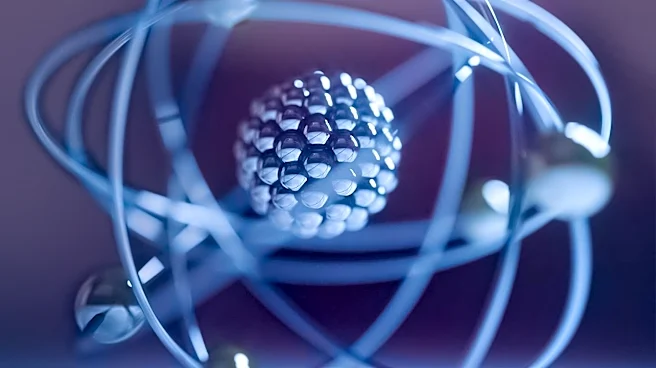
of Energy’s (DOE) Brookhaven National Laboratory through the Visiting Faculty Program (VFP). Burson and her students have spent three summers at Brookhaven’s Center for Functional Nanomaterials (CFN), utilizing advanced research tools and expertise. The grant will support extended research visits to Brookhaven Lab, allowing Burson to continue her work on developing materials for capturing and separating noble gases. Her research focuses on creating small 'nano cages' that can trap noble gases, offering a more energy-efficient alternative to the current industry standard of cryogenic distillation. This method aims to work at room temperature, significantly reducing energy consumption.
Why It's Important?
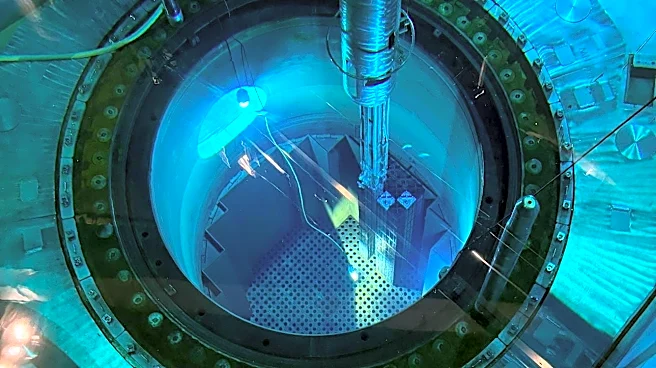
This NSF grant is significant for several reasons, impacting both scientific research and potential industrial applications in the U.S. The development of more cost-effective and energy-efficient methods for noble gas separation could revolutionize industries that rely on these gases, such as those producing neon signs, scientific research, and medical applications. Furthermore, the research has critical environmental and safety implications. It addresses the mitigation of harmful noble gases like radon, a leading cause of lung cancer in the U.S., and krypton and xenon, byproducts of nuclear energy production. Efficient removal of these byproducts can enhance the safety and efficiency of nuclear energy facilities. The collaboration between Grinnell College and Brookhaven Lab, facilitated by the VFP, also highlights the importance of federal programs in fostering scientific talent and providing access to state-of-the-art facilities for academic researchers and their students, thereby strengthening the U.S. scientific workforce.
What's Next?
With the new NSF grant, Professor Burson plans to continue her research at Brookhaven Lab, with extended visits supported by the funding. She will return to Brookhaven this fall as a facility user to study materials at CFN and the National Synchrotron Light Source II (NSLS-II). The project will further explore different material combinations and the interaction between gas size and cage size to optimize noble gas capture and separation. The ongoing collaboration with Brookhaven scientists and the use of advanced equipment are expected to yield further insights and potential breakthroughs in this field. The success of her students in securing prestigious scholarships and presenting at major conferences suggests a continued focus on mentorship and student involvement, ensuring the development of future scientists in the U.S.
Beyond the Headlines
Beyond the immediate scientific advancements, this grant and the ongoing collaboration underscore a broader trend in U.S. scientific policy: the emphasis on inter-institutional partnerships and the development of a skilled scientific workforce. The Visiting Faculty Program, which enabled Burson's initial engagement with Brookhaven, serves as a model for how national laboratories can leverage academic expertise while providing invaluable research opportunities for faculty and students from smaller institutions. This not only democratizes access to cutting-edge research facilities but also fosters a diverse talent pipeline for critical scientific fields. The focus on energy-efficient and environmentally beneficial technologies, such as noble gas separation, aligns with national priorities for sustainable development and public health, demonstrating how fundamental research can have far-reaching societal impacts.