
What's Happening?
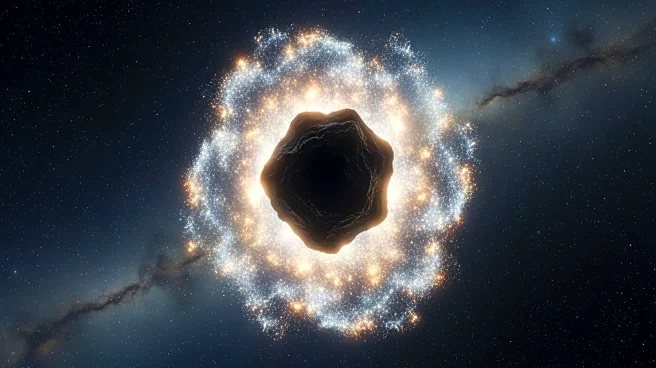
Astronomers have identified a massive cloud of vaporized metal, measuring approximately 120 million miles wide, that temporarily obscured the light from a distant star, J0705+0612, located about 3,000
light-years away. This event, first observed in September 2024, involved the star dimming significantly for nine months before returning to its normal brightness. The cloud is believed to be gravitationally bound to a mystery object, potentially a massive planet or a low-mass star, which exerts enough gravitational force to hold the cloud together. Using the Gemini South telescope and other observatories, researchers mapped the cloud's internal gas motions, discovering it is rich in elements heavier than hydrogen and helium, such as iron and calcium. This marks the first time astronomers have measured the internal gas motions of a disk orbiting a secondary object like a planet or low-mass star.
Why It's Important?
This discovery is significant as it provides new insights into the dynamics of planetary systems and the interactions between stars and their surrounding materials. The ability to map the internal gas motions of such a cloud could enhance our understanding of planetary formation and the evolution of celestial bodies. The findings suggest that even in mature planetary systems, dramatic events like large-scale collisions can occur, challenging previous assumptions about the stability of such systems. This research could lead to further studies on the formation of circumplanetary and circumsecondary disks, potentially impacting theories on planet and star formation.
What's Next?
Future research will likely focus on identifying the nature of the mystery object holding the cloud together. Determining whether it is a massive planet or a low-mass star could provide further insights into the formation and evolution of planetary systems. Additionally, continued observations and analysis of similar events could help refine models of celestial dynamics and the lifecycle of stars and planets. The research team may also explore the potential for similar occurrences in other star systems, broadening the scope of astronomical studies.