



What's Happening?
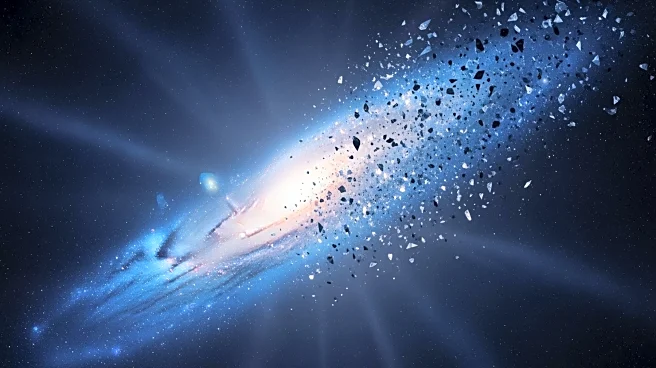
A study by researchers at Radboud University in the Netherlands suggests that the universe may end sooner than previously thought due to quantum effects. The study explores how black holes and dense stars like neutron stars can lose mass through a Hawking-like
evaporation process. This process, driven by quantum fields in curved spacetime, could lead to the eventual disappearance of even the most massive objects in the universe. The researchers argue that these quantum effects, although subtle, could have significant implications for the ultimate fate of the universe.
Why It's Important?
The study challenges existing notions about the permanence of massive cosmic objects and the long-term evolution of the universe. By suggesting that quantum effects could lead to the evaporation of black holes and neutron stars, the research raises questions about the ultimate fate of the universe and the forces that govern it. Understanding these processes could provide new insights into the interplay between quantum physics and general relativity, potentially leading to breakthroughs in theoretical physics and cosmology.
What's Next?
Further research is needed to explore the implications of these findings and to determine whether the proposed quantum effects can be observed or measured. Scientists will continue to investigate the interactions between quantum fields and curved spacetime to refine their understanding of these processes. The study highlights the need for interdisciplinary collaboration between astrophysics, quantum physics, and mathematics to address fundamental questions about the universe's future. As research progresses, scientists hope to gain a clearer picture of the universe's ultimate fate and the forces that shape it.