


What's Happening?
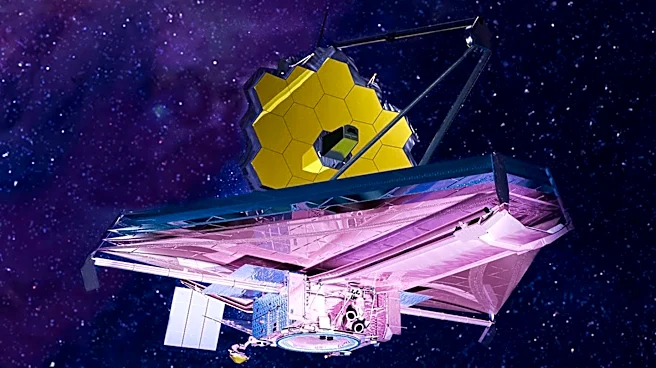
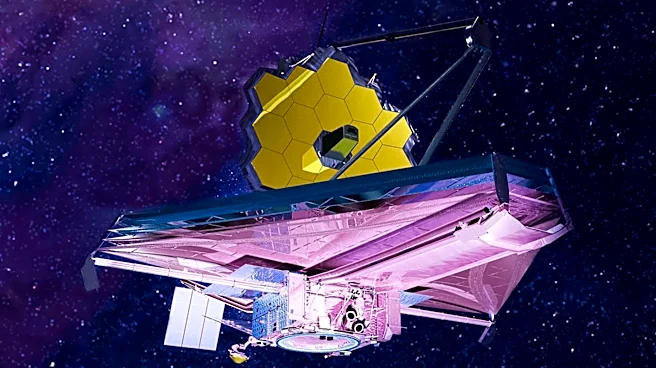
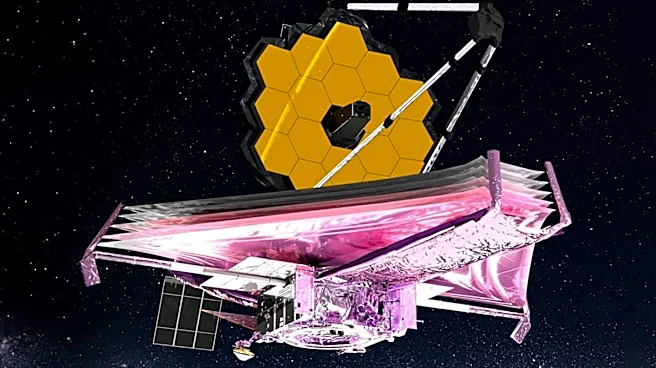
Astronomers have identified a unique cosmic entity, described as a hybrid between a black hole and a star, which could provide new insights into the early universe. This discovery, detailed in the journal Nature, was made using the James Webb Space Telescope
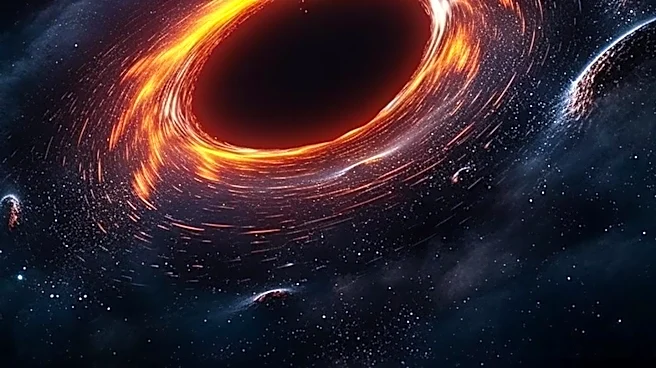
during a project aimed at identifying the oldest galaxies. The object, named MoM-BH-1, is a bright red dot from the early universe, with a star-like gas cloud the size of our solar system and a black hole component 100,000 times the size of the sun. This hybrid emits 100 times more energy than any known stellar formation and is 100 billion times brighter than the average star, outshining its host galaxy. The discovery of MoM-BH-1 could help explain the mysterious red dots observed by the telescope, which were prevalent in the universe's first two billion years.
Why It's Important?
The discovery of MoM-BH-1 is significant as it challenges existing cosmological models and offers a potential explanation for the early universe's supermassive black holes. Understanding these black hole stars could provide insights into the formation and evolution of galaxies and the universe itself. The findings suggest that the red dots observed in the early universe might be black hole stars, rather than supermassive stars or galaxies, as previously thought. This could lead to a reevaluation of how scientists understand the universe's infancy and the processes that led to the formation of its earliest structures.
What's Next?
Researchers plan to continue studying MoM-BH-1 and similar objects using the James Webb Space Telescope. Starting in December, they aim to investigate the size and atmospheric composition of these black hole stars. This ongoing research could further illuminate the nature of these cosmic phenomena and refine our understanding of the universe's early stages. The study of MoM-BH-1 may also inspire new theoretical models and simulations to better predict the behavior and characteristics of such hybrid entities.