



What's Happening?
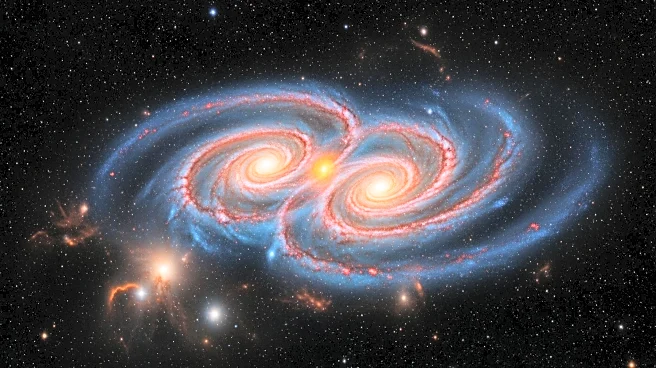
The James Webb Space Telescope (JWST) has captured a striking image of two colliding spiral galaxies, NGC 2207 and IC 2163, located 120 million light-years away in the constellation Canis Major. The image combines infrared data from JWST with X-ray data from the Chandra
X-ray Observatory, revealing the intricate interactions between the galaxies. The gravitational forces between the galaxies are distorting their spiral arms, leading to the formation of new stars. This observation is part of JWST's mission to study the centers of merging galaxies and improve models of galactic interactions.
Why It's Important?
The image of NGC 2207 and IC 2163 provides valuable insights into the processes that occur during galactic mergers. Such interactions are fundamental to understanding the evolution of galaxies and the formation of stars. The combination of infrared and X-ray data allows scientists to study both the cooler material and high-energy regions within the galaxies, offering a comprehensive view of the dynamics at play. This research contributes to the broader understanding of cosmic structures and the forces that shape them, enhancing our knowledge of the universe's history and future.