
What's Happening?
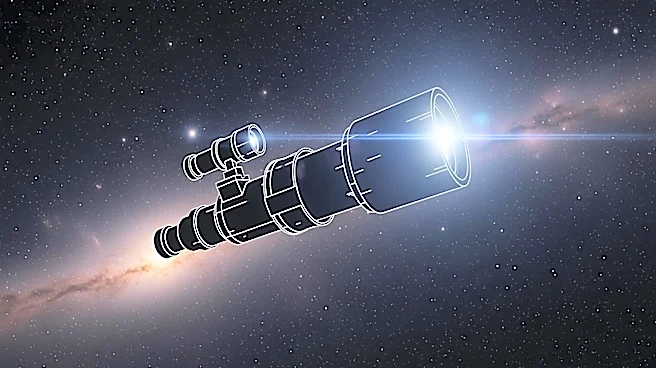
The PoET telescope, located at the European Southern Observatory's Paranal Observatory in Chile, has successfully completed its initial observations. This telescope is designed to help astronomers differentiate
signals from exoplanets from the 'noise' generated by stars. The PoET telescope, equipped with a 60-centimeter mirror, studies specific regions of the solar disk, including sunspots, while a smaller telescope records the total light from the Sun. This dual observation method allows scientists to better understand how stellar activity affects spectral data, aiding in the search for Earth-like planets. The data collected is processed by the ESPRESSO spectrograph, which operates at night to search for planets orbiting distant stars.
Why It's Important?
The successful deployment of the PoET telescope represents a significant advancement in the search for Earth-like exoplanets. By improving the ability to filter out stellar noise, astronomers can more accurately identify potential habitable planets. This research could lead to groundbreaking discoveries about the existence of life beyond our solar system and enhance our understanding of planetary formation and evolution. The project also highlights the importance of international collaboration in advancing astronomical research and technology.
What's Next?
Following the successful 'first light' observations, the PoET telescope team is finalizing system calibration, with regular scientific data collection set to begin soon. The results will be made available to the global scientific community through the ESO archive, potentially leading to new discoveries and collaborations. As the telescope continues its observations, it may identify new exoplanets, contributing to the growing catalog of known planets and informing future space exploration missions.