
What's Happening?
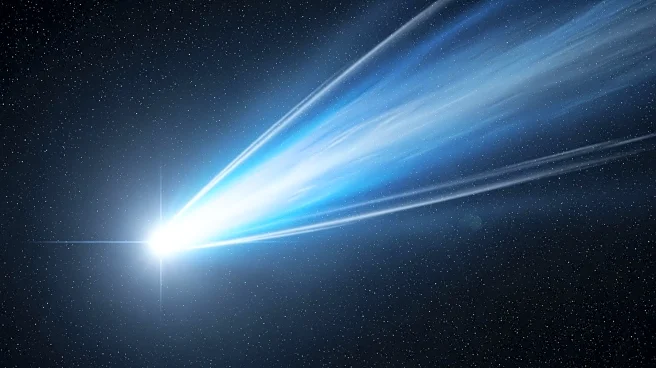
Comet 3I/ATLAS, the third interstellar object known to pass through our solar system, is accelerating as it approaches its closest point to Earth. Scientists have observed significant non-gravitational
accelerations in the comet, attributed to the release of gas as it nears the Sun. Despite its acceleration, NASA confirms that there is no danger to Earth, as the comet will come no closer than 170 million miles. 3I/ATLAS was first discovered in July by NASA’s ATLAS survey telescope in Chile and is on a hyperbolic trajectory, indicating it is not bound by the Sun's gravity and is merely passing through the solar system.
Why It's Important?
The study of 3I/ATLAS provides valuable data on interstellar objects, enhancing our understanding of their behavior and composition. The comet's acceleration due to gas release offers insights into the physical processes affecting such objects as they interact with the Sun. This information is crucial for developing models of cometary behavior and understanding the dynamics of interstellar visitors. The ability to track and study these objects as they pass through the solar system helps scientists learn more about the materials and conditions present in other star systems, potentially informing theories about the formation of planets and the potential for life elsewhere in the universe.
What's Next?
As 3I/ATLAS continues its journey through the solar system, scientists will monitor its trajectory and behavior to gather more data. The comet's closest approach to Earth is projected for December 19, providing a window for further observation. This ongoing research will contribute to the broader understanding of interstellar objects and their interactions with solar systems. Future studies may focus on comparing 3I/ATLAS with other interstellar comets to identify commonalities and differences in their chemical compositions and physical characteristics.