
What's Happening?
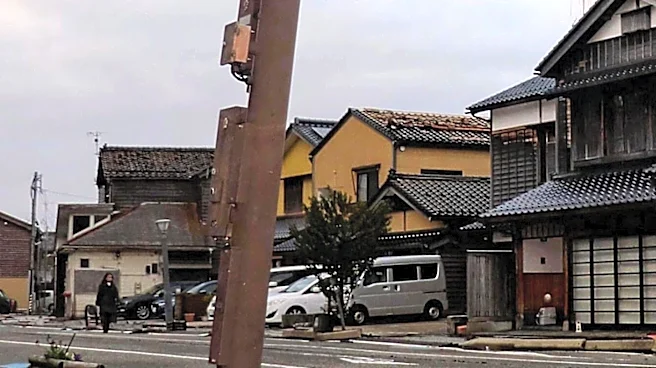
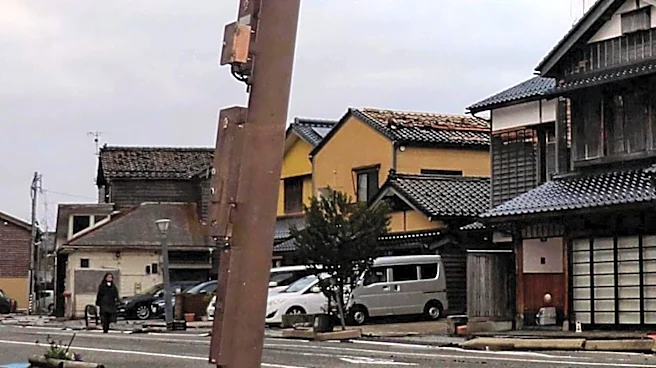
A magnitude 4.9 earthquake occurred off the Pacific coast of eastern Japan on November 10, 2026, at 05:20 UTC (2:20 p.m. local time). The epicenter was approximately 78 kilometers east-southeast of Hitachi
in Ibaraki Prefecture, at a depth of about 30 kilometers. No tsunami warning was issued, and no casualties or damage have been reported. This event is part of a cluster of seismic activities in the region, which began on November 9 with a magnitude 5.9 earthquake (Japan Meteorological Agency) or 5.7 (USGS) off the Ibaraki coast. Tremors from the November 9 quake were felt as far as Tokyo. Additionally, a magnitude 6.1 earthquake had struck the same offshore area on November 6. The European-Mediterranean Seismological Centre (EMSC) and USGS both recorded the November 10 event, with slight variations in depth measurements.
Why It's Important?
This series of earthquakes is significant because it is occurring in a region where researchers have confirmed that the Japan Trench plate boundary is re-locking and accumulating energy following the 2011 Great East Japan Earthquake. A team from Tohoku University, the Japan Agency for Marine-Earth Science and Technology, and the University of Tokyo's Earthquake Research Institute has used GNSS-A technology to measure seafloor displacement, indicating this energy accumulation. While researchers emphasize that this re-locking is a standard post-major-earthquake phase and does not forecast an imminent event, continued monitoring is crucial for earthquake and tsunami preparedness across eastern Japan. The region's location on the Pacific Ring of Fire makes it highly susceptible to seismic activity, and understanding these patterns is vital for long-term disaster mitigation strategies.
What's Next?
The Japan Meteorological Agency (JMA) and the USGS will continue to monitor the ongoing seismic activity in the region. Researchers will maintain their close watch on the Japan Trench plate boundary to track the accumulation of compressive energy. While no imminent major earthquake is predicted, the data gathered from these events will contribute to a better understanding of seismic risks and inform future earthquake and tsunami preparedness measures. The differing magnitude measurements between the JMA and USGS highlight the complexities of seismic monitoring and the importance of comprehensive data analysis from multiple sources to assess potential impacts.
Beyond the Headlines
The ongoing seismic cluster off Ibaraki underscores the long-term geological processes at play in tectonically active regions like Japan. The re-locking of the Japan Trench plate boundary, a decade and a half after the devastating 2011 earthquake, illustrates the cyclical nature of seismic stress buildup and release. This phenomenon presents a continuous challenge for urban planning, infrastructure development, and public awareness campaigns in Japan. The scientific community's ability to monitor these subtle shifts in the Earth's crust, even without predicting immediate events, is critical for enhancing resilience against future natural disasters and highlights the ethical imperative of investing in advanced seismological research and early warning systems.