
What's Happening?
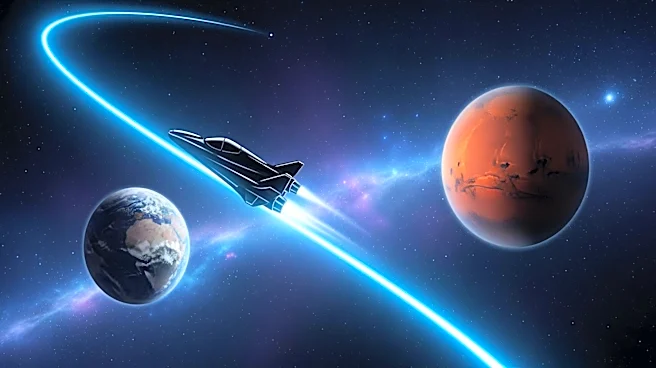
A new study suggests that early asteroid trajectory data could be used to design faster missions to Mars, potentially reducing round-trip travel time to under a year. The research, inspired by the orbital
paths of near-Earth asteroids, proposes that these trajectories could offer geometric clues for more efficient interplanetary routes. The study's author, Marcelo de Oliveira Souza, identified a potential 153-day round-trip mission during the 2031 Mars opposition, using a trajectory similar to an asteroid's early orbital plane.
Why It's Important?
This discovery could revolutionize space travel by significantly reducing the time required for missions to Mars. Shorter travel times would decrease the risks and costs associated with long-duration space missions, making Mars exploration more feasible. This advancement could accelerate human exploration of Mars and potentially lead to new opportunities for scientific research and commercial ventures. However, the feasibility of such missions depends on advancements in spacecraft technology and propulsion systems.
What's Next?
Further research and technological development are needed to determine the practical application of these findings. Space agencies and private companies may explore the potential of using asteroid-inspired trajectories for future Mars missions. The study could also prompt discussions on the design and capabilities of next-generation spacecraft, such as SpaceX's Starship, to achieve the required speeds for these rapid transfers.