


What's Happening?
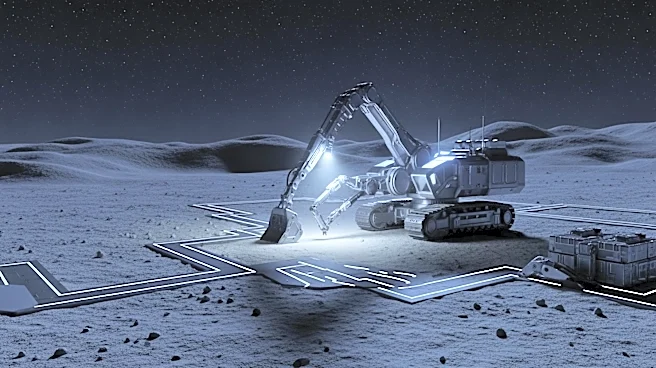
Astroport Space Technologies and Vermeer Corporation have announced a collaboration to adapt industrial surface mining equipment for autonomous lunar construction. This partnership aims to develop the heavy machinery, referred to as 'Lunar Iron,' necessary
for building a permanent human presence on the Moon. The announcement was made at the 20th International Conference on Engineering, Science, Construction and Operations in Challenging Environments in College Station, Texas. The collaboration focuses on the 'lunarisation' of Vermeer’s surface mining machinery using Astroport’s Universal Tool Implement Payload Adapter (UTIPA), a modular system designed for robotic construction in the Moon’s extreme environment. The equipment will be adapted to function in the Moon’s low gravity, extreme temperature swings, and abrasive regolith. This initiative aligns with NASA’s Moon Base program, which aims to construct lunar infrastructure by 2030.
Why It's Important?
The collaboration between Astroport and Vermeer is significant as it addresses the engineering challenges of constructing a permanent lunar base, a key component of NASA’s Moon Base program. The development of autonomous machinery capable of operating in the Moon’s harsh environment is crucial for site preparation, road construction, and infrastructure development necessary for permanent habitation. This partnership highlights the growing commercial and political momentum towards establishing a sustainable human presence on the Moon. The ability to perform heavy civil engineering on the Moon at scale is a bottleneck that this collaboration aims to overcome, potentially positioning Astroport and Vermeer as leaders in lunar construction technology.
What's Next?
Prototype testing of the adapted machinery will take place at Vermeer’s headquarters in Pella, Iowa. The focus will initially be on adapting Vermeer’s high-torque cutting and trenching technologies for the lunar surface. The partnership aligns with NASA’s timeline for lunar landings beginning in 2028, with permanent habitation targeted by 2030. The success of this collaboration could lead to significant contracts for Astroport and Vermeer as the U.S. government has committed to permanent lunar habitation by the end of the decade. The companies are betting on adapting proven Earth-based technologies for lunar use to meet the demands of this ambitious timeline.
Beyond the Headlines
The development of autonomous lunar construction machinery has broader implications for the space industry and international collaboration. The ability to construct a permanent lunar base could pave the way for further exploration and utilization of lunar resources, such as helium-3, which has potential applications in nuclear fusion. The partnership also highlights the importance of international cooperation in space exploration, as Astroport operates in multiple countries, positioning it across major spacefaring blocs. The success of this initiative could set a precedent for future collaborations in space infrastructure development.