






What's Happening?
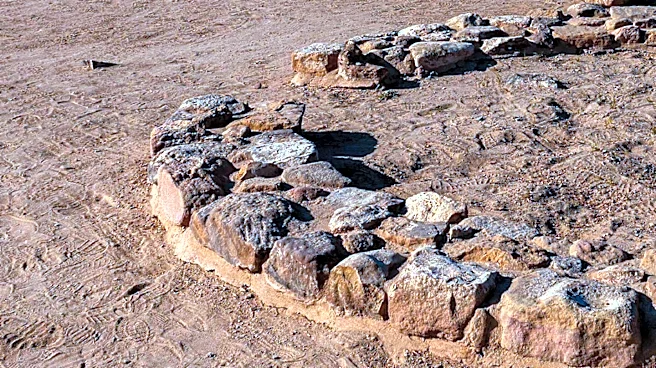
RAF pilots flying over the Middle East in the 1920s discovered large stone structures known as 'desert kites.' These structures, which are invisible from the ground, consist of two long stone walls converging into an enclosure with a tail. More than 6,000
of these kites have been identified across the region, from Uzbekistan to Libya. The structures were built to trap animals, with walls laid along breaks in the slope to guide animals into pits. The oldest kites date back to the early Holocene, making them some of the most complex structures of their time. Despite their historical significance, few have been excavated, and their exact purpose remains a topic of debate among archaeologists.
Why It's Important?
The discovery of desert kites provides valuable insights into ancient human ingenuity and adaptation to harsh environments. These structures highlight the sophisticated methods used by early humans to hunt and manage wildlife. Understanding their construction and use can shed light on the social and economic practices of ancient communities in the Middle East. The ongoing debate about their purpose—whether for trapping wild game or managing livestock—reflects broader questions about human adaptation and survival strategies in prehistoric times. The study of these kites also contributes to the broader field of archaeology by offering a glimpse into the technological advancements of early civilizations.
Beyond the Headlines
The existence of desert kites raises questions about the cultural and environmental factors that influenced their construction. Their widespread distribution suggests a shared knowledge or cultural exchange among ancient communities across the Middle East. The structures also prompt discussions about the impact of climate and environmental changes on human societies. As research continues, these kites may reveal more about the interactions between ancient humans and their environment, as well as the development of early engineering techniques.