






What's Happening?
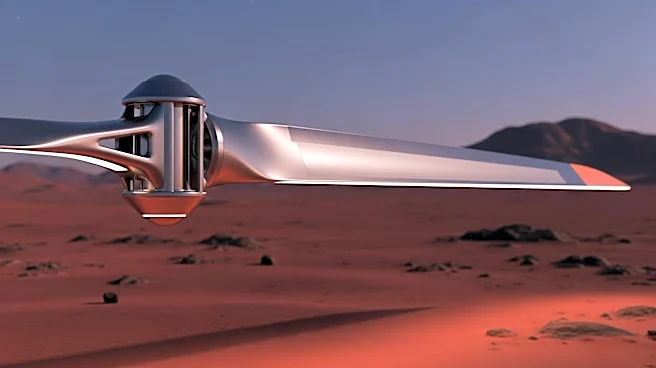
Engineers at NASA's Jet Propulsion Laboratory have made a significant breakthrough in rotor technology, which could enhance future Mars exploration missions. Building on the success of the Ingenuity helicopter, which completed 72 flights on Mars, the team
has developed next-generation rotorcraft capable of carrying heavier payloads over longer distances. This advancement involves increasing rotor tip speeds to Mach 1.08, boosting lift capability by 30 percent. The new technology will be utilized in the upcoming SkyFall mission, set to launch as early as 2028, which will deploy three helicopters to Mars aboard a nuclear-powered spacecraft.
Why It's Important?
This breakthrough in rotor technology is crucial for the future of space exploration, particularly in the context of Mars missions. The ability to carry heavier scientific payloads and travel longer distances will enable more comprehensive exploration of the Martian surface, potentially leading to new discoveries. The development also underscores NASA's commitment to advancing aerospace technology and maintaining its leadership in space exploration. The success of these next-generation rotorcraft could influence future mission designs and inspire further innovations in aerospace engineering.
What's Next?
NASA plans to continue refining the rotor technology and preparing for the SkyFall mission. The agency will conduct further tests to ensure the reliability and safety of the new rotorcraft. As the mission approaches, NASA will also focus on integrating the rotorcraft with other mission components and coordinating with international partners. The aerospace community will be closely monitoring these developments, as they could have far-reaching implications for the future of planetary exploration.