





What's Happening?
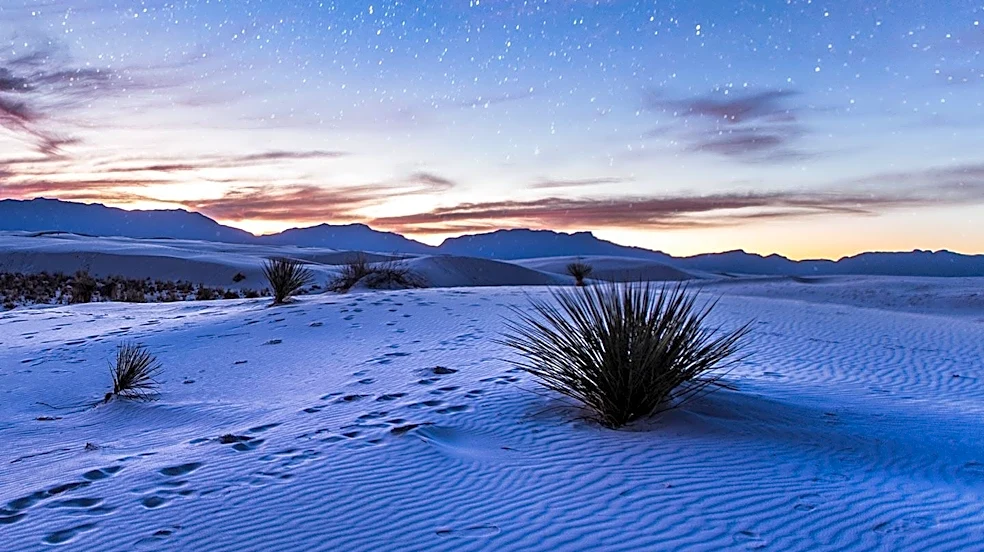
Expanded excavations at White Sands National Park in New Mexico have provided researchers with a refined timeline for the oldest human footprints in North America. A new study, published in Science Advances by a team including the University of Arizona
and the United States Geological Survey, indicates that the humans who left these tracks experienced rapid environmental changes within their lifetimes. The research team previously identified these footprints as the earliest evidence of human presence in North America, dating them thousands of years earlier than previously believed. The study utilized innovative extraction procedures for pollen grains and refined dating methods from the USGS Radiocarbon Laboratory, confirming the footprints date back to between 23,500 and 21,700 years ago, during the Last Glacial Maximum. This precise chronology has allowed for a deeper understanding of the abrupt environmental shifts faced by early humans in the region.
Why It's Important?
This research significantly alters our understanding of early human adaptation and resilience in North America. It highlights that these ancient populations were not merely static inhabitants but active witnesses to dramatic environmental transformations, including shifts from conifer forests to sagebrush and oak steppes, and the recession of Lake Otero. The ability to reconstruct environmental conditions at a temporal resolution equivalent to a human generation (approximately 50 years) is rare for terrestrial paleoclimate archives from the southwestern U.S. This provides crucial insights into how early humans coped with rapid climate change, offering a historical parallel to contemporary environmental challenges. The findings also reinforce the oral traditions of sovereign Native nations, providing scientific evidence that Indigenous peoples have inhabited these lands for an extended period, humanizing the deep Indigenous past of the Americas.
What's Next?
Researchers plan to further investigate the mechanisms behind these rapid environmental changes, specifically exploring how a warming event in Greenland could have led to increased aridity in the American Southwest. This will involve delving deeper into the interconnectedness of global climate systems and their regional impacts. The ongoing study aims to expand the understanding of the complete context of conditions during the Last Glacial Maximum at the White Sands site. This continued research will likely yield more detailed information about the specific challenges faced by these early human populations and their adaptive strategies, potentially informing modern approaches to environmental change and human resilience.
Beyond the Headlines
The study's findings have profound implications beyond paleoclimate reconstruction, touching upon cultural and ethical dimensions. By scientifically validating the long-standing oral traditions of Indigenous peoples regarding their ancient presence in North America, the research contributes to a more inclusive and accurate historical narrative. It underscores the deep connection between Indigenous communities and their ancestral lands, reinforcing their claims to a history that predates conventional archaeological timelines. Furthermore, the discovery that early humans experienced significant climate shifts within their lifetimes offers a powerful historical perspective on the human capacity to adapt to environmental instability, prompting reflection on contemporary climate challenges and the long-term resilience of human societies.