What's Happening?
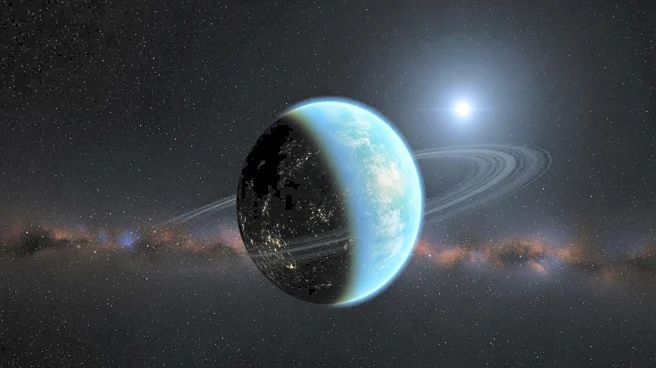
The James Webb Space Telescope is providing new insights into the TRAPPIST-1 system, which consists of seven Earth-sized rocky planets orbiting a red dwarf star. This system, located 40 light-years away, offers a unique opportunity to study planets that
are similar to Earth in size and composition. Webb's observations have focused on the atmospheres of these planets, particularly TRAPPIST-1 b, c, d, and e. So far, Webb has not detected thick atmospheres on TRAPPIST-1 b and c, suggesting they may be bare rocks or have very thin atmospheres. The data for TRAPPIST-1 d and e is still under analysis, but thick hydrogen atmospheres have been ruled out. The system's compactness and the proximity of the planets to their host star make it an ideal target for studying planetary atmospheres and potential habitability.
Why It's Important?
The TRAPPIST-1 system is a key focus for astronomers studying exoplanets and the potential for life beyond Earth. The ability to analyze the atmospheres of these planets provides critical information about their composition and potential habitability. Webb's advanced capabilities allow for detailed atmospheric characterization, which is essential for understanding the conditions that might support life. The findings from the TRAPPIST-1 system contribute to the broader field of exoplanet research, helping scientists understand the diversity of planetary systems and the factors that influence habitability. This research also informs future missions and the search for biosignatures on exoplanets.
What's Next?
Continued observations with the James Webb Space Telescope will focus on further characterizing the atmospheres of the TRAPPIST-1 planets. Scientists aim to determine the presence and composition of any atmospheres, which could provide clues about the planets' potential to support life. Future missions, such as the Habitable Worlds Observatory, will build on Webb's findings to explore Earth-sized exoplanets around red dwarf stars. The ongoing study of the TRAPPIST-1 system will enhance our understanding of planetary formation and the conditions necessary for life, driving the search for habitable worlds beyond our solar system.