
What's Happening?
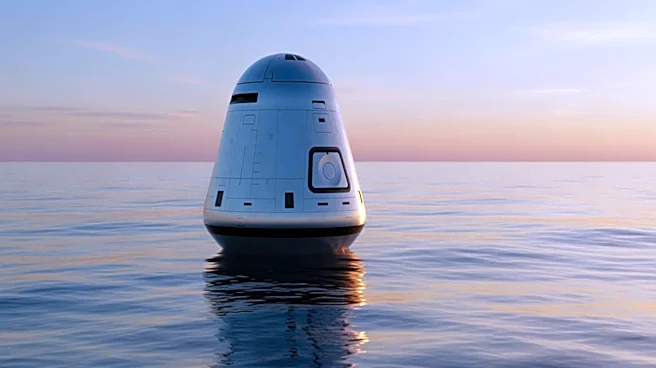
On April 6, 2026, the Artemis 2 mission achieved a new milestone in space exploration. The four astronauts aboard NASA's Orion spacecraft, part of the Artemis 2 mission, and the three crew members on China's Tiangong space station were recorded as being
farther apart than any other humans in history. This record was noted by astrophysicist Jonathan McDowell, who calculated the maximum distance between the two groups as 260,754 miles. This surpasses the previous record set during the Apollo 13 mission in 1970. The Artemis 2 mission, which involves a crewed flyby of the moon, is part of NASA's efforts to return humans to lunar exploration.
Why It's Important?
This achievement underscores the advancements in international space exploration and collaboration. The Artemis 2 mission is a critical step in NASA's Artemis program, which aims to establish a sustainable human presence on the moon. The record distance highlights the growing capabilities of space agencies to conduct complex missions beyond Earth's orbit. It also reflects the increasing role of international partnerships in space exploration, as demonstrated by the simultaneous missions of NASA and China's space agency. This milestone could inspire further cooperation and competition in space exploration, potentially accelerating technological advancements and scientific discoveries.
What's Next?
Following the Artemis 2 mission, NASA plans to continue its Artemis program with subsequent missions aimed at landing astronauts on the lunar surface. These missions will focus on establishing a sustainable presence on the moon, which is seen as a stepping stone for future human exploration of Mars. The success of Artemis 2 could influence future international collaborations and partnerships in space exploration. Additionally, the data and experiences gained from this mission will inform the planning and execution of future deep space missions, potentially leading to new scientific discoveries and technological innovations.