






What's Happening?
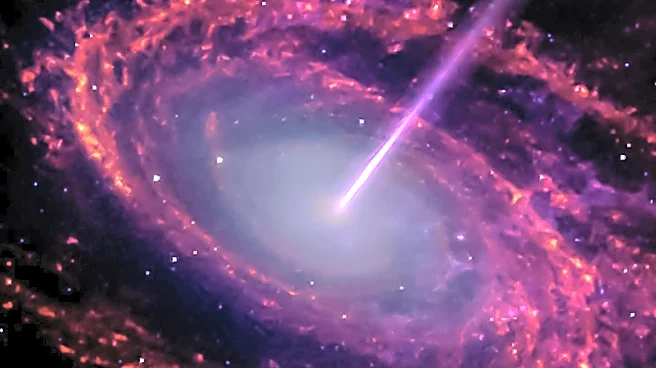
Astronomers have identified a previously unknown population of 'radio galaxies' exhibiting fading 'radio lobes.' This discovery sheds light on the processes that occur when the supermassive black holes powering these vast outflows of plasma cease their
activity. The research team investigated 14 candidate faded or remnant radio galaxies within the XMM–Newton Large-Scale Structure (XMM–LSS) field, a region of the sky extensively studied by the XMM-Newton X-ray spacecraft. Radio galaxies are characterized by their intense radio wave emissions and expansive gas lobes that can extend for millions of light-years. Remnant radio galaxies represent the final stage of their evolution, where the jets from the central active galactic nuclei (AGNs), fueled by supermassive black holes, have shut down. Consequently, these jets can no longer replenish the radio lobes, leading to their gradual fading. The study utilized the MeerKAT radio telescope in South Africa, the Jansky Very Large Array, and the LOFAR (Low-Frequency Array) network to analyze these celestial objects.
Why It's Important?
This discovery significantly enhances our understanding of the life cycles of galaxies and the behavior of supermassive black holes. By observing these fading radio galaxies, scientists can gain insights into the mechanisms that cause supermassive black holes to 'turn off' and the subsequent evolution of their surrounding structures. The ability to study how radio emissions change as particles within the lobes age and lose energy provides crucial data for astrophysical models. The finding that many of these remnants have a younger 'fade age' than previously measured suggests that astronomers might have overlooked a population of short-lived remnants, indicating a more dynamic and varied evolutionary path for radio galaxies. This research contributes to a more complete picture of galactic evolution, impacting our understanding of the universe's large-scale structures and the role of black holes within them.
What's Next?
The research team confirmed that 12 of the 14 candidates are indeed remnant radio galaxies, with the remaining two still active. A notable finding was the age of these remnants, which had been fading for periods ranging from 8 million to 42 million years, with an average 'fade age' of 12 million years. This average age is younger than previously recorded for other radio galaxy remnants, suggesting the existence of a population of shorter-lived remnants. Furthermore, the study revealed that the observed remnants are in various evolutionary stages, from those whose jets have recently ceased to others that powered down much earlier. Future research will likely focus on further characterizing these short-lived remnants and exploring the factors that contribute to the diverse evolutionary stages observed. Continued observations with advanced radio telescopes will be crucial for refining these findings and uncovering more about the complex interplay between supermassive black holes and their host galaxies.
Beyond the Headlines
The identification of these fading radio galaxies offers a unique window into the transient phases of galactic activity. It highlights the dynamic nature of supermassive black holes, which are not perpetually active but undergo periods of intense feeding followed by dormancy. This cyclical behavior has profound implications for the energy output of galaxies and their impact on the intergalactic medium. Understanding these 'off' phases is critical for comprehending how galaxies regulate their star formation and overall growth. The diverse evolutionary stages observed among the remnants suggest that the 'turn-off' process of supermassive black holes might not be uniform, potentially influenced by factors such as the availability of fuel, galactic mergers, or internal feedback mechanisms. This research pushes the boundaries of our knowledge regarding the cosmic ecosystem, emphasizing the intricate and often subtle processes that shape the universe over vast timescales.