


What's Happening?
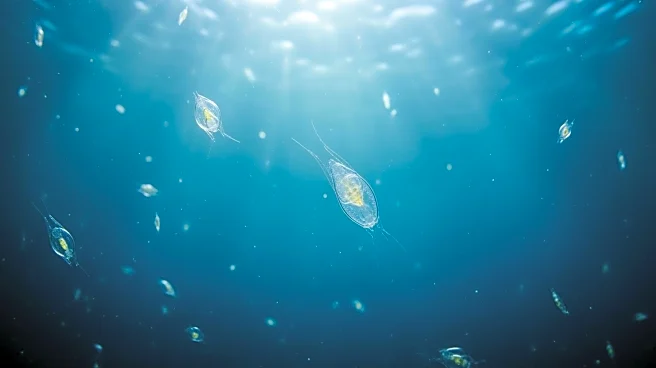
A recent study led by the Institute of Environmental Science and Technology at the Universitat Autònoma de Barcelona reveals that current climate models may be underestimating the role of calcifying plankton in regulating Earth's climate. These microscopic
organisms, which include coccolithophores, foraminifers, and pteropods, are crucial in capturing carbon and facilitating its movement through the ocean. The study indicates that these plankton are not adequately represented in climate models, potentially leading to an incomplete understanding of the ocean's response to climate change. The research emphasizes the importance of these organisms in the ocean carbon pump, a process that stabilizes Earth's climate by moving carbon from the atmosphere to the ocean's depths.
Why It's Important?
The exclusion of calcifying plankton from climate models could result in significant gaps in predicting how the ocean and atmosphere interact, particularly in the context of climate change. These organisms play a vital role in the global carbon cycle, affecting seawater chemistry and sediment formation, which are essential for studying past climates. By not accounting for processes like shallow dissolution, where a significant portion of calcium carbonate dissolves in the upper ocean, models may misjudge carbon movement and the ocean's response to environmental stress. This oversight could lead to inaccurate predictions of climate dynamics, affecting policy decisions and strategies for mitigating climate change impacts.
What's Next?
The study calls for urgent efforts to better measure the production, dissolution, and export of calcium carbonate by different plankton groups. Incorporating these details into climate models could enhance predictions of long-term carbon storage and improve the understanding of ocean-atmosphere interactions. This integration is crucial for developing more accurate climate models that reflect the biological complexity of the oceans, ultimately aiding in more effective climate change mitigation strategies.
Beyond the Headlines
The study highlights the diverse responses of different plankton groups to climate threats, such as ocean acidification and rising temperatures. Understanding these differences is essential for accurately modeling the ocean's carbon storage and recycling processes. By treating these organisms as a single group, current models may oversimplify the ocean's response to climate pressures, potentially overlooking critical dynamics that influence global climate patterns.