



What's Happening?
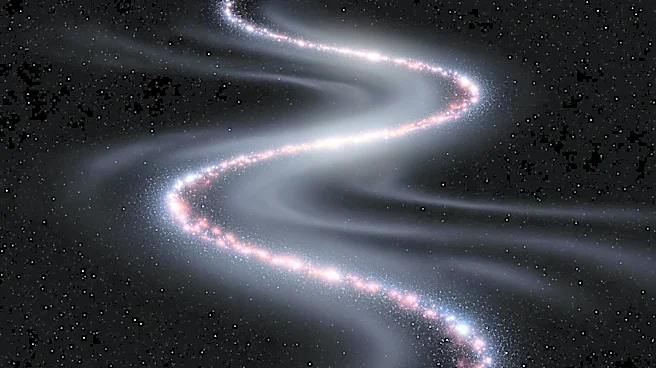
Astronomers have identified a multitude of faint stellar streams at the periphery of the Milky Way, using data from the European Space Agency's Gaia mission. These streams, which are arcing threads of stars, can be multiplied four times more than previously
found. The discovery was made possible through a new algorithm that analyzes the gravitational interactions within the galaxy. These stellar streams are formed when compact star clusters travel through the Milky Way's gravitational field, leaving behind trails of stars. This finding provides new insights into the evolution of the Milky Way and the distribution of its dark matter, which acts as an invisible 'glue' holding galaxies together.
Why It's Important?
The discovery of these stellar streams is significant as it enhances the understanding of the Milky Way's structure and the distribution of dark matter. Dark matter, although not directly observable, plays a crucial role in the formation and stability of galaxies. By mapping these streams, scientists can better estimate the mass of the Milky Way, including its elusive dark matter halo. This research could lead to advancements in astrophysics, offering a clearer picture of how galaxies evolve and interact. The findings also underscore the importance of the Gaia mission in providing critical data for such astronomical discoveries.
What's Next?
Future research will likely focus on further analyzing these stellar streams to refine models of the Milky Way's mass and dark matter distribution. Scientists may also explore similar phenomena in other galaxies to compare and contrast with the Milky Way. Continued advancements in data analysis techniques and algorithms will be essential in uncovering more about the universe's structure. Additionally, the findings could influence the development of new technologies and methodologies in space exploration and observation.
Beyond the Headlines
The implications of this discovery extend beyond immediate scientific understanding. It highlights the potential for international collaboration in space research, as missions like Gaia involve multiple countries and institutions. The study of dark matter and stellar streams also raises philosophical questions about the universe's composition and the nature of unseen forces. As technology advances, the ability to detect and analyze such phenomena will likely lead to more groundbreaking discoveries, reshaping humanity's understanding of the cosmos.