




What's Happening?
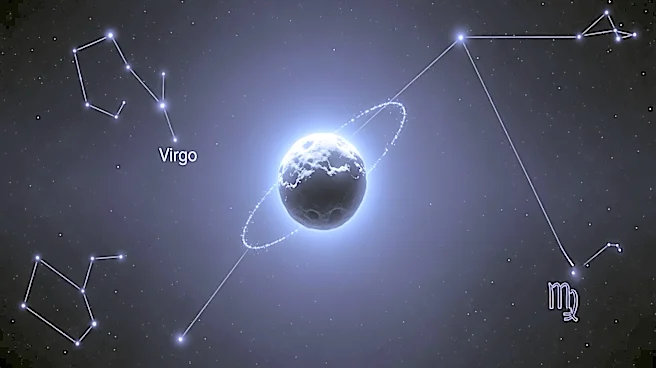
Astronomy enthusiasts are being treated to a celestial event as the 11th-magnitude asteroid 13 Egeria moves through the Virgo constellation. This event provides an opportunity for observers to track the asteroid's motion against stationary background
stars. Egeria is currently positioned near some 9th- and 10th-magnitude stars, making it visible to those with telescopes. Observers are encouraged to photograph or sketch the asteroid's position and return after a few hours to note its movement. This event is part of a broader interest in tracking celestial bodies and understanding their paths through the night sky.
Why It's Important?
The movement of Egeria offers a practical exercise for amateur astronomers to engage with the night sky and develop their observational skills. Tracking such asteroids contributes to a broader understanding of the solar system's dynamics and the behavior of objects within it. This event also highlights the importance of public engagement in astronomy, fostering a deeper appreciation for space science and potentially inspiring future generations of astronomers. The ability to observe and document such movements enhances public interest and education in astronomy.
What's Next?
Observers are encouraged to continue monitoring Egeria's path as it progresses through Virgo. This ongoing observation can contribute to amateur astronomical records and provide data for future studies. Additionally, similar events involving other celestial bodies are expected to occur, offering further opportunities for public engagement and education in astronomy. The continued interest in such events may lead to increased participation in astronomy clubs and educational programs.