



What's Happening?
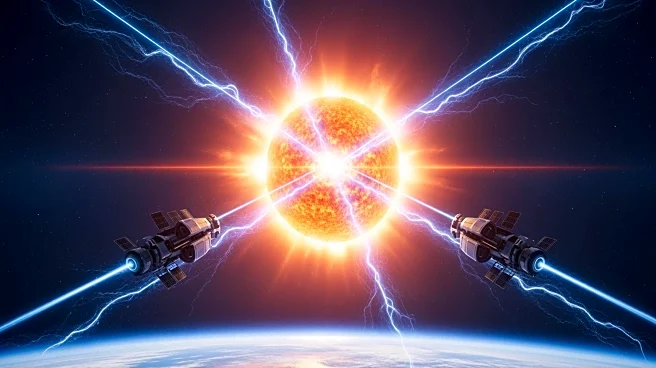
Astrophysicist Sarah Thiele and her team have raised concerns about the increasing risk of satellite collisions in low-Earth orbit, particularly during solar storms. The overcrowding of this orbital space, primarily due to the proliferation of internet
satellites, has heightened the potential for catastrophic events. The team has developed the Collision Realization and Significant Harm (CRASH) Clock, which currently indicates a mere 5.5 days to avert a collision if satellite operations are disrupted by a solar storm. This is a significant reduction from the 164 days available in 2018. The CRASH Clock takes into account all objects in low-Earth orbit, including defunct satellites and debris. The urgency of the situation was highlighted by the Gannon storm of 2024, which nearly reached the CRASH limit, necessitating maneuvers for almost half of the satellites in orbit.
Why It's Important?
The potential for satellite collisions poses a significant threat to global communications and navigation systems, which are heavily reliant on these satellites. A collision could lead to a cascade of debris, further complicating space operations and increasing the risk of additional collisions. This situation underscores the need for sustainable management of orbital space, which the United Nations has declared a finite resource. The increasing frequency of maneuvers to avoid collisions also introduces risks, such as inaccuracies in satellite positioning and potential miscommunications. These challenges highlight the need for improved satellite management and coordination to prevent a space-based catastrophe.
What's Next?
Efforts to mitigate the risk of satellite collisions will likely involve international cooperation to establish guidelines for satellite launches and operations. This could include stricter regulations on the number of satellites allowed in orbit and improved tracking systems to monitor satellite positions more accurately. Additionally, advancements in technology may be necessary to enhance the resilience of satellites against solar storms and other space weather events. The development of more efficient collision avoidance systems and strategies will be crucial in ensuring the long-term sustainability of low-Earth orbit.
Beyond the Headlines
The overcrowding of low-Earth orbit not only threatens satellite operations but also impacts astronomical research due to increased light pollution. The presence of numerous satellites can obscure observations of faint celestial objects, hindering scientific discoveries. Furthermore, the accumulation of space debris poses a long-term environmental challenge, as it can remain in orbit for decades, complicating future space missions. Addressing these issues will require a comprehensive approach that balances technological advancement with environmental stewardship.