





What's Happening?
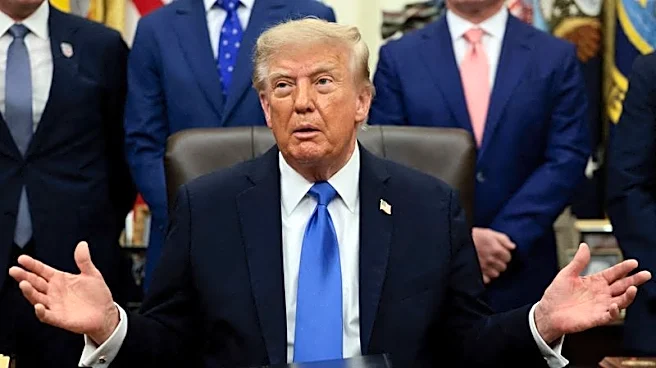
U.S. President Donald Trump has announced plans to establish a dedicated Artificial Intelligence (AI) Force, modeled after the Space Force, and to appoint an 'AI czar' to oversee the sector. This initiative aims to foster the free development of AI technology
while ensuring the United States maintains its competitive edge over China. President Trump made these announcements on Truth Social on September 19, likening the significance of AI to the Industrial Revolution and the advent of the internet. He projects that the AI industry could eventually contribute as much as 25% to the nation's gross domestic product, potentially reaching $7.7 trillion annually based on 2025 GDP figures. The president emphasized that the new structure would not impose stricter regulations on developers, stating that the government would instead nurture the industry's growth. He also indicated that any 'bad actors' would be addressed through existing criminal and civil justice systems. The specific operational details of the AI Force and the selection process for its leadership remain undisclosed, though President Trump stated that the 'AI czar' would be a high-IQ individual.
Why It's Important?
This proposal is significant as it outlines a potential new federal approach to artificial intelligence, a technology widely recognized as a cornerstone of future economic and military power. By creating an 'AI Force' and an 'AI czar,' President Trump signals a strategic intent to centralize and prioritize AI development at a national level, similar to how the Space Force elevated space operations. This move could streamline federal support and investment in AI research and development, potentially accelerating innovation within U.S. tech companies. The emphasis on avoiding new restrictions on developers suggests a policy aimed at fostering rapid growth, which could be beneficial for tech companies seeking less regulatory burden. However, it also raises questions about the balance between innovation and responsible AI development, particularly concerning ethical considerations and potential societal impacts. The initiative is explicitly framed within the context of the U.S.-China competition for AI leadership, highlighting the geopolitical stakes involved and the potential for this policy to influence global technological dominance.
What's Next?
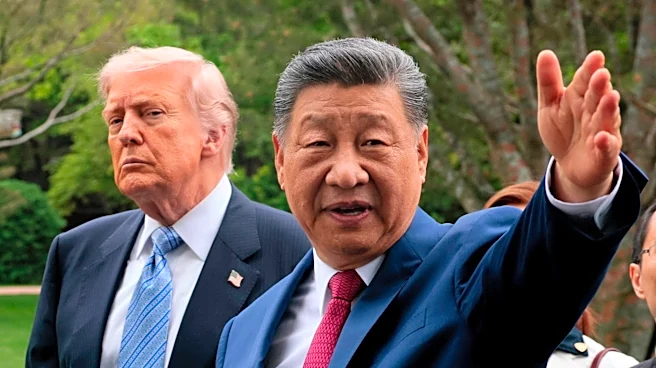
The implementation of President Trump's proposed AI Force and the appointment of an 'AI czar' will likely require legislative action, as was the case with the Space Force. This means the initiative will need to navigate through Congress, which is responsible for approving funding and establishing new federal entities. The nature of the AI Force—whether it will be a military organization or a civilian agency—remains unclear, and this distinction will significantly influence the legislative path and the type of congressional support required. President Trump is expected to announce the name of the 'AI czar' in the near future. The proposal also comes just days before a scheduled meeting between President Trump and Chinese leader Xi Jinping, where AI safety, trade, and other economic issues are expected to be discussed. This timing suggests that AI will be a prominent topic in future U.S.-China relations, with potential implications for international cooperation or competition in the field. The debate between fostering innovation and implementing robust regulation for AI is also likely to intensify among U.S. lawmakers and technology companies.
Beyond the Headlines
The creation of an 'AI Force' and the appointment of an 'AI czar' could have profound long-term implications beyond immediate policy changes. Ethically, the decision to prioritize rapid AI development with minimal new restrictions raises concerns about accountability, bias, and the potential for misuse of advanced AI systems. While President Trump mentioned addressing 'bad actors' through existing justice systems, the rapid evolution of AI may present novel challenges that current legal frameworks are ill-equipped to handle. Culturally, this initiative could further embed AI into the national consciousness as a critical domain, potentially influencing educational priorities, workforce development, and public perception of technology. The comparison to the Space Force suggests a militarization or national security framing of AI, which could shape how the technology is developed and deployed, potentially leading to a more competitive and less collaborative global AI landscape. The emphasis on maintaining a lead over China also underscores a broader geopolitical shift where technological supremacy is increasingly intertwined with national power and influence.