




What's Happening?
President Abdel Fattah el-Sisi has revived Egypt's ambitious Toshka project, also known as New Valley, which aims to create a second Nile Valley in the desert. Initiated in 1997 under Hosni Mubarak, the project's goal is to alleviate population concentration
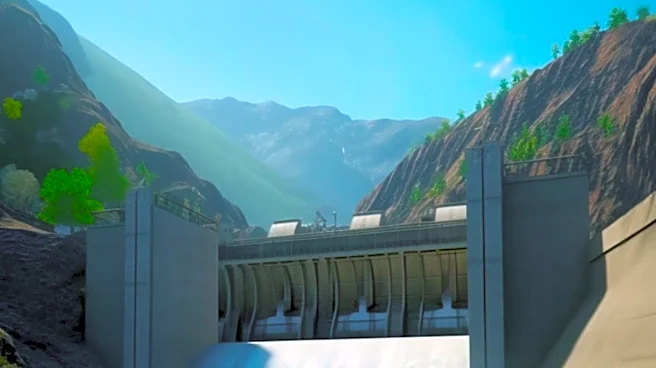
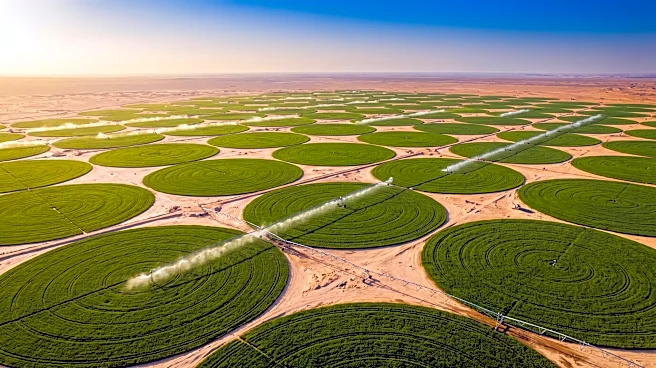
along the Nile River, where over 95% of Egyptians reside. The project involves diverting water from Lake Nasser to irrigate hundreds of thousands of hectares of desert land for cultivation and to establish new cities. Since 2020, the Egyptian state has intensified efforts, deploying companies, machinery, power stations, pumping systems, and large-scale pivot irrigation equipment. By 2023, authorities reported tens of thousands of hectares incorporated into new phases, with significant plantings of wheat and palm trees, aligning with a strategy focused on food security. Despite initial challenges and slow progress in developing urban areas and attracting investment, the project continues to be a major undertaking nearly three decades after its inception, with Egypt striving to justify the extensive infrastructure built.
Why It's Important?
The revitalization of the Toshka project is crucial for Egypt's long-term stability and development, addressing critical issues such as overpopulation, food security, and economic diversification. By expanding arable land, Egypt aims to reduce its reliance on food imports and create new employment opportunities outside the densely populated Nile Valley. This initiative could significantly transform the country's demographic distribution and economic landscape. However, the project faces inherent challenges, including the high cost of operation, soil salinity, groundwater issues, and difficulties in attracting sufficient investment. The success of Toshka could serve as a model for large-scale desert reclamation in arid regions globally, demonstrating how engineering feats can tackle environmental and demographic pressures. Conversely, if the project continues to struggle with economic viability and social integration, it could represent a substantial misallocation of resources, potentially exacerbating existing political and social tensions, particularly concerning water distribution and land claims by communities near Lake Nasser.
What's Next?
Egypt is expected to continue its intensive efforts to develop the Toshka project, with a strong focus on agricultural expansion and food security. The government will likely persist in deploying resources and attracting investment to establish the necessary infrastructure for cultivation and urban development. Future steps will involve overcoming the challenges of soil characteristics, water management, and economic sustainability to ensure the project's long-term success. The authorities will need to demonstrate that the new agricultural areas can generate sufficient economic returns and create sustainable communities to justify the massive investment. Additionally, there will be ongoing efforts to integrate the new territories into the national economy and address any social or environmental concerns that arise from such a large-scale transformation of the desert landscape. The project's progress will be closely watched as a benchmark for Egypt's ability to manage its resources and population growth.
Beyond the Headlines
The Toshka project highlights the complex interplay between engineering ambition, environmental constraints, and socio-economic realities in a water-scarce region. While the engineering feat of bringing water to the desert is impressive, the deeper challenge lies in creating a self-sustaining ecosystem that includes not just agriculture but also thriving communities and industries. The project's history reveals that simply providing water does not automatically lead to a 'second Nile Valley'; it requires comprehensive planning for human settlement, economic activity, and ecological balance. The ethical implications of diverting vast amounts of water, especially in a region with competing water demands, are also significant. The project's impact on local communities, particularly the Nubians who claim ancestral lands in the area, adds a layer of social complexity. Ultimately, Toshka is a testament to humanity's desire to overcome geographical limitations, but it also serves as a cautionary tale about the multifaceted challenges of large-scale environmental transformation and the need for integrated development strategies.