
What's Happening?
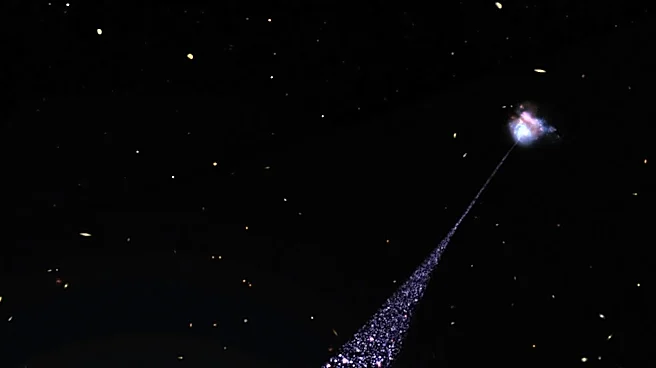
Astronomers have observed a 'runaway' supermassive black hole, named RBH-1, traveling through space at nearly 1,000 km/s. This black hole was detected by the James Webb Space Telescope and the Hubble Space Telescope. Researchers from the Kavli Institute
for Theoretical Physics, University of California-Santa Barbara, and the University of Texas at Austin have suggested that RBH-1 was ejected into space due to the merger of two supermassive black holes. This event is considered a significant confirmation of Einstein's general theory of relativity, as it demonstrates a gravitational-wave recoil following a black hole merger.
Why It's Important?
The discovery of RBH-1 provides a unique opportunity to study the dynamics of supermassive black hole mergers and the resulting gravitational-wave recoils. This event offers insights into the evolution of galaxies and their central black holes. Understanding these processes is crucial for astrophysics, as it helps scientists reconstruct the history of cosmic events and the formation of galaxies. The findings could also inform future gravitational-wave research, enhancing our knowledge of the universe's most extreme environments.
What's Next?
Researchers plan to use this discovery to further study supermassive black hole mergers and their effects on galaxy evolution. Future observations by the James Webb Space Telescope, the Nancy Grace Roman Space Telescope, and other observatories will aim to identify more recoiling supermassive black holes. These efforts will complement direct gravitational-wave observations by the upcoming Laser Interferometer Space Antenna (LISA), providing a more comprehensive understanding of these cosmic phenomena.